


Cyber security certifications Australia employers list in job ads have narrowed sharply over the past couple of years. With thousands of certifications on the market, hiring managers now lean on a short, fairly predictable list when they’re screening resumes and candidates who chase the wrong certification often spend money and months without moving the needle on job offers. This guide ranks the cyber security certifications Australia employers actually ask for in 2026, from entry-level through to leadership, with the city-by-city demand and the fastest path to each one.
How This List Was Ranked
Certifications here are ranked on three things employers in Australia consistently care about: how often the certification appears by name in job ads, whether it’s vendor-neutral or tool-specific, and how directly it maps to a defined career stage (entry, mid, senior, or leadership). Vanity certifications with no clear employer demand were left off, even where they’re popular on training marketplaces.
The Top 10 Cyber Security Certifications Employers Value in Australia
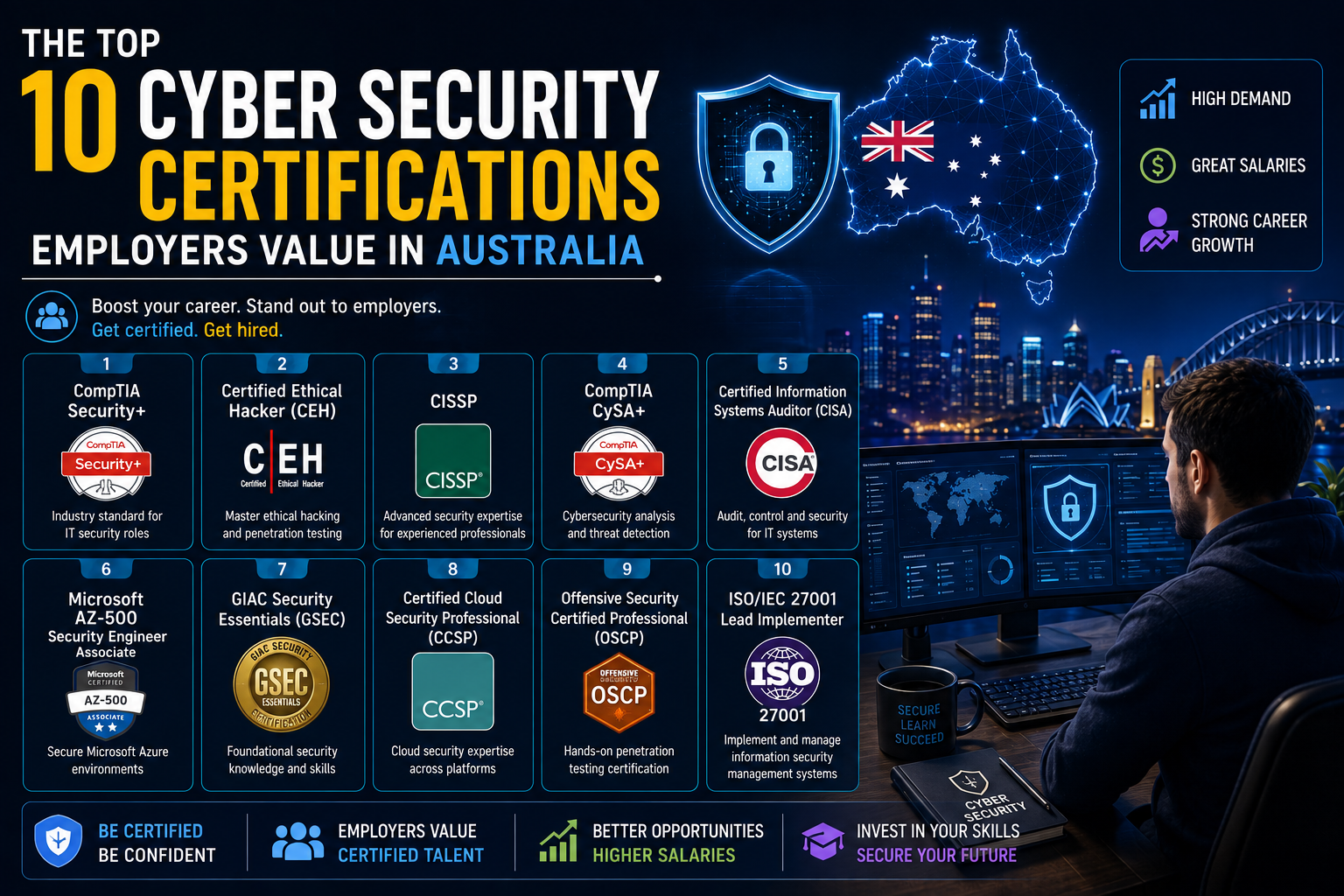
1. CompTIA Security+
The most consistently requested entry-level credential in Australian cyber security job ads. It’s vendor-neutral, covers network security, threats, incident response, and identity management, and is accepted across government, finance, and telecom. For career-changers and IT support staff moving into security, this is almost always the first certification worth earning.
2. ISC2 Certified in Cybersecurity (CC)
A newer but fast-growing entry-level credential from the same body behind CISSP. Employers increasingly accept it alongside Security+ as proof of foundational knowledge, and it’s a useful stepping stone toward CISSP later in a career.
3. CompTIA CySA+
The natural next step after Security+, aimed squarely at SOC analyst and threat-detection roles. CySA+ shows up repeatedly in Australian job ads for security analyst positions and signals hands-on capability with monitoring, log analysis, and incident response.
4. CompTIA PenTest+
For candidates targeting offensive security and penetration testing roles without yet having the experience for OSCP. PenTest+ is vendor-neutral and increasingly listed as a preferred credential for junior penetration tester and vulnerability assessment roles.
5. Certified Ethical Hacker (CEH)
Still widely recognised across Australian employers for offensive security roles, CEH teaches the same techniques attackers use, within a legal framework. It’s commonly paired with PenTest+ or OSCP on a resume rather than used alone.
6. Microsoft Azure Security Engineer (AZ-500)
As more Australian businesses run production workloads on Azure, AZ-500 has become one of the fastest-growing cloud security certifications by employer demand, particularly in Sydney and Melbourne where enterprise Azure adoption is highest.
7. Cisco CCNA (Security Track)
Not a pure security certification, but network fundamentals remain a real gap for many cyber security candidates. CCNA is frequently listed as a preferred credential for network security and infrastructure-adjacent roles, especially in Perth’s energy sector and Adelaide’s defence industry.
8. CISSP (Certified Information Systems Security Professional)
The benchmark certification for senior and lead security roles in Australia. CISSP requires several years of relevant experience to earn, and it appears constantly in job ads for security architect, security manager, and senior consultant positions across every major city.
9. CISM (Certified Information Security Manager)
Where CISSP is broad and technical, CISM is built for professionals moving into security management and governance. It’s heavily requested for roles that sit between technical security teams and business leadership, and is a strong complement to CISSP rather than a replacement for it.
10. CISA (Certified Information Systems Auditor)
The standard certification for IT audit, risk, and compliance roles in Australia, especially in banking, insurance, and government. As regulatory requirements around cyber resilience increase, CISA-certified professionals are in growing demand for both in-house and consulting roles.
Cyber Security Certifications Australia Employers Want, by Career Stage
| Career Stage | Certifications | Typical Roles |
| Entry-level | Security+, ISC2 CC | IT support, junior SOC analyst |
| Early career | CySA+, PenTest+, CCNA | SOC analyst, junior pentester, network security |
| Mid-career | CEH, AZ-500 | Penetration tester, cloud security engineer |
| Senior / Leadership | CISSP, CISM, CISA | Security architect, security manager, IT auditor |
Cyber Security Certification Demand by Australian City
Employer demand for specific certifications shifts noticeably depending on which industries dominate the local job market:
| City | Dominant Industries | Certifications in Highest Demand |
| Sydney | Banking, finance, consulting | Security+, CISSP, AZ-500 |
| Melbourne | Corporate, tech, retail | CySA+, AZ-500, CISM |
| Brisbane | Government, healthcare | Security+, CySA+, CISA |
| Perth | Mining, resources, energy | CCNA, Security+, CISSP |
| Adelaide | Defence, government | CCNA, CISSP, CISA |
| Canberra | Federal government, defence | Security+, CISSP, CISM |
Wherever you’re based, Logitrain’s cyber security certifications are delivered live online, so location doesn’t limit which of these ten you can train for. If you’re starting from scratch with no IT background, cybersecuritycourse.au maps out the full beginner pathway before you commit to a specific certification.
How to Choose the Right Certification First
- No IT background yet: start with CompTIA Security+ or ISC2 CC.
- Already in IT support, want to move into security operations: CySA+.
- Interested in offensive security / penetration testing: PenTest+ then CEH.
- Working with cloud infrastructure: AZ-500.
- Have 4+ years of security experience and want a leadership track: CISSP or CISM.
- Interested in audit, risk, and compliance: CISA.
Frequently Asked Questions
Which cyber security certification do Australian employers value most?
CompTIA Security+ remains the most consistently requested certification across entry-level cyber security certifications Australia job ads, while CISSP is the clearest benchmark for senior and leadership roles.
Do I need a degree as well as a certification to get a cyber security job in Australia?
Not always. Many Australian employers, particularly for SOC analyst and junior roles, treat a recognised certification like Security+ or CySA+ as equivalent proof of job-ready skills, especially when paired with hands-on lab experience.
Is CISSP worth it if I’m still early in my career?
CISSP requires several years of relevant experience to certify, so it’s generally a mid-to-senior career goal rather than a starting point — CySA+ or AZ-500 are more realistic next steps for early-career professionals.
Which certification is best for cloud security roles in Australia?
Microsoft AZ-500 is currently the most requested cloud security certification in Australian job ads, reflecting how widely Azure is used by local enterprises.
Final Thoughts
The cyber security certifications Australia employers actually value in 2026 form a fairly clear ladder: Security+ or ISC2 CC to start, CySA+ or PenTest+ to specialise, AZ-500 for cloud, and CISSP, CISM, or CISA once you’re ready for senior or leadership roles. Start with Logitrain’s cyber security certifications, delivered live online across Sydney, Melbourne, Brisbane, Perth, Adelaide, and Canberra, or see the full Logitrain course catalogue for adjacent IT and cloud certifications.