

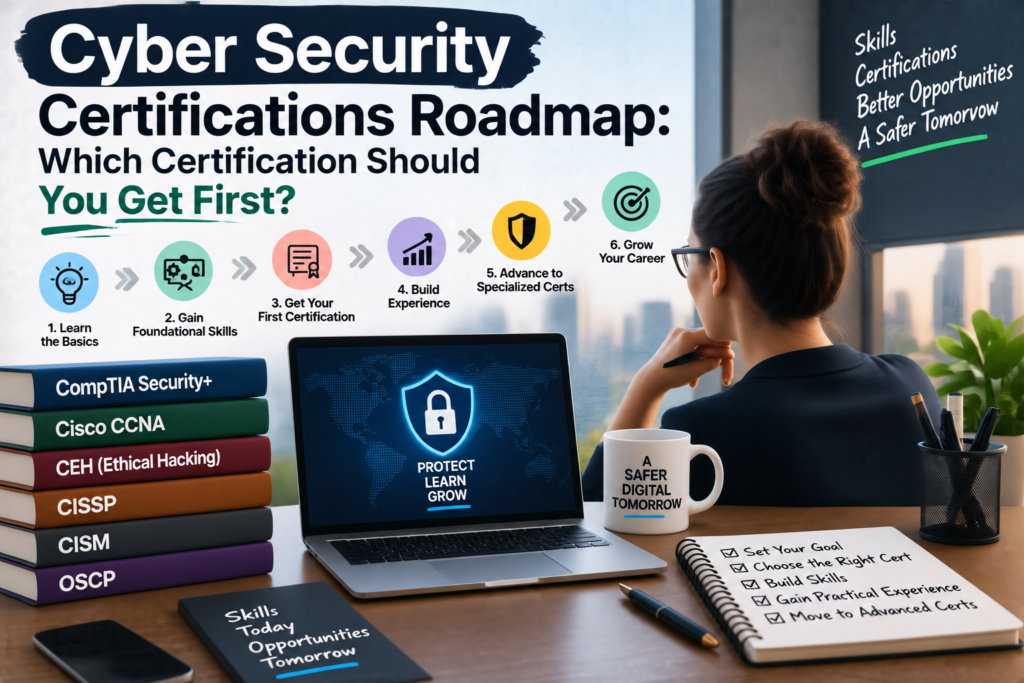


Which cyber security certification to get first is the question that stalls more careers than any skills gap does. Most beginners in Sydney, Melbourne, Brisbane, Perth, Adelaide and Canberra don’t fail because they picked a “bad” certification they stall because they picked certifications in the wrong order, chasing an advanced credential before the fundamentals were solid, or collecting entry-level certs indefinitely instead of moving on.
This guide lays out a clear first, second and third certification sequence for the most common cyber security career tracks, so you always know what to study next instead of guessing.
Why Order Matters More Than Most People Think
Certifications build on each other in a specific way: foundational certifications establish shared vocabulary and broad security concepts, specialist certifications prove you can apply that knowledge in a specific function (SOC analyst, penetration testing, cloud security), and advanced or governance-level certifications prove you can lead or design security programs. Skipping straight to an advanced certification without the foundation usually means studying concepts you can’t yet apply to real scenarios which is also why so many candidates who jump ahead fail their first attempt.
Your First Certification: Build the Foundation
For almost every track, the first certification should be CompTIA Security+, or for candidates specifically targeting Microsoft/Azure environments, Microsoft SC-900. Both are vendor-neutral or entry-level enough to build genuine foundational knowledge without assuming prior security experience.
Why Security+ (or SC-900) comes first
- Covers core concepts — threats, cryptography basics, network security, risk that every later certification assumes you already know
- Recognised broadly across industries, not locked into one vendor ecosystem
- Often required or preferred for entry-level SOC analyst and IT security roles in Australia
- Builds exam-taking confidence before tackling harder, scenario-heavy certification exams
Your Second Certification: Choose Your Specialisation
The second certification is where your career track should start to diverge. This is the point to choose a direction based on the type of work you actually want to do, not the certification with the most impressive-sounding name.
If you want to work in a Security Operations Centre (SOC)
CompTIA CySA+ is the natural second step it builds directly on Security+ with a focus on threat detection, log analysis and incident response, which maps closely to real SOC analyst work.
If you’re targeting Microsoft/Azure security roles
Microsoft SC-200 (Security Operations Analyst) is the strongest second step, since it tests hands-on skills in Microsoft Sentinel and Defender tools that dominate Australian enterprise environments already running Microsoft 365 and Azure.
If you’re drawn to offensive security / penetration testing
CompTIA PenTest+ provides a structured, vendor-neutral introduction to ethical hacking methodology before candidates attempt harder practical exams like OSCP.
If you’re interested in cloud security specifically
Microsoft AZ-500 (Azure Security Engineer) is the logical second step for candidates who completed SC-900 first, extending that foundation into hands-on Azure security configuration.
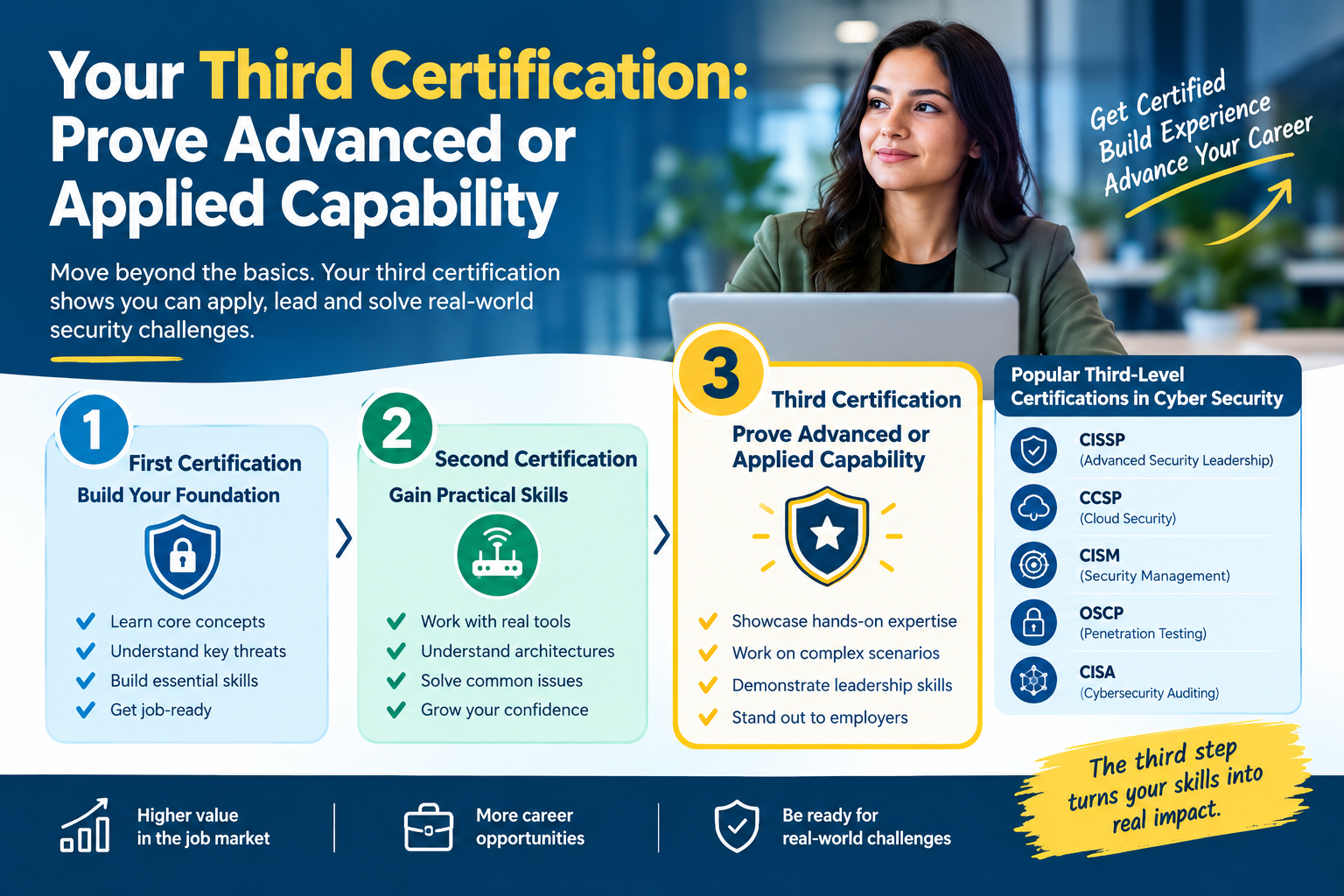
Your Third Certification: Prove Advanced or Applied Capability
The third certification is where candidates separate themselves from the broader entry-level pool. This stage usually means either a harder, hands-on practical exam within the same track, or a governance/leadership certification if the goal is to move toward security management.
Advanced technical options
- SOC track: GIAC certifications (e.g. GCIH) or vendor-specific SIEM deep dives
- Cloud security track: Advanced Azure/AWS security specialisations beyond AZ-500
- Offensive security track: OSCP the practical, hands-on standard the industry treats as a genuine skill filter
Governance and leadership options
- CISSP — for candidates aiming toward senior analyst, architect or management roles
- CISM — for candidates specifically targeting security management and risk leadership
Certification Order at a Glance
| Track | First | Second | Third |
| General / SOC Analyst | Security+ | CySA+ | GIAC (GCIH) or CISSP |
| Microsoft / Azure Security | SC-900 | SC-200 | AZ-500 or CISSP |
| Cloud Security | SC-900 | AZ-500 | Advanced cloud security specialisation |
| Offensive Security / Pentest | Security+ | PenTest+ | OSCP |
| Governance / Leadership | Security+ | CySA+ or SC-200 | CISM or CISSP |
Common Ordering Mistakes to Avoid
- Attempting CISSP or OSCP before any foundational certification both assume experience most beginners don’t have yet
- Collecting multiple entry-level certifications (e.g. several vendor-neutral basics) instead of progressing to a specialisation
- Choosing a second certification based on job-ad keyword frequency rather than genuine interest in the work itself
- Leaving 12+ months between certifications, which forces you to re-learn foundational material before attempting the next exam
Where to Build This Roadmap Properly
Structured training makes this sequence far more manageable than self-study alone, especially for the specialisation stage. The Cyber security certification courses at cybersecuritycertifications.au are mapped directly to this first-second-third structure, and for candidates still deciding on a starting point, our beginner’s cyber security roadmap at cybersecuritycourse.au covers the no-experience entry point in more depth.
Frequently Asked Questions
Which cyber security certification should I get first with no experience?
CompTIA Security+ is the most broadly recommended first certification in Australia, since it covers foundational concepts that every later certification assumes you already understand.
How long should I wait between certifications?
Most successful candidates space certifications 3–6 months apart enough time to genuinely apply the knowledge, but not so long that foundational material needs to be re-learned.
Do I need three certifications to get hired as a cyber security analyst?
Not always many entry-level SOC analyst roles in Australia only require Security+. A second, specialised certification like CySA+ or SC-200 significantly improves competitiveness, and a third becomes more relevant once you’re targeting senior or leadership roles.
Final Thoughts
Which cyber security certification to get first, second and third isn’t really a question with one universal answer but it does follow a consistent logic: foundation, specialisation, then advanced or leadership capability. Candidates in Sydney, Melbourne, Brisbane, Perth, Adelaide and Canberra who follow this order consistently move faster than candidates who chase certifications out of sequence or collect entry-level credentials without ever specialising.
To plan this out properly, Logitrain offers training mapped to every stage of this roadmap, and the cybersecuritycertifications.au and cybersecuritycourse.au microsites cover the full path from first certification through to specialisation.