


Professionals who become indispensable in cyber security are not always the most technical people in the room. They are the ones whose absence would genuinely hurt the business. Their work cannot be handed to a script, an outsourced provider or a new graduate with the same certification. In a field that is growing fast but also automating fast, that difference decides who gets promoted and who gets quietly restructured.
This guide explains the replacement risk in cyber security careers, the seven signs that you may be easier to replace than you think, and the practical steps that help you become indispensable in cyber security instead. You will also find a certification pathway, a 90-day plan, city-by-city insight for Sydney, Melbourne, Brisbane, Perth, Adelaide and Canberra, and the training that supports each step.
What Is the Replacement Risk in a Cyber Security Career?
The replacement risk is the chance that your role, your skills or your contribution can be taken over by someone or something cheaper, faster or equally capable. It does not mean your job is about to disappear. It means your position depends on narrow, easily copied value, such as running one tool, following one playbook or holding one certificate that thousands of other people also hold.
Cyber security has a strong demand story, and it is true that skilled people are needed. But demand does not protect every individual equally. Employers still make choices about who to hire, retain and promote. Those choices favour professionals who bring something the market cannot easily substitute, which is exactly what it means to become indispensable in cyber security. Those who become indispensable in cyber security are chosen on purpose, not by accident.
Why It Pays to Become Indispensable in Cyber Security
There is a financial and career case for this, not just a security-of-employment one. Professionals who become indispensable in cyber security tend to be involved earlier in projects, trusted with higher-risk decisions and considered first for senior roles. Their salary conversations are different too, because the business can see exactly what it would lose without them.
They also have more choice. When you become indispensable in cyber security, you are not at the mercy of one employer’s restructure. Your reputation, relationships and portfolio of results travel with you, which makes it easier to move, negotiate or step into leadership when you are ready.
Put simply, the goal is not to hoard knowledge or make yourself hard to replace through secrecy. The goal is to create so much clear, visible value that the organisation wants to keep investing in you.
Why the Replacement Risk Is Rising
Several forces are making routine security work easier to replace, even as the overall field expands.
- Automation and AI: tools such as Microsoft Security Copilot, SOAR platforms and automated detection now handle alert triage, summarisation and basic investigation that used to fill a junior analyst’s day.
- Managed security services: many organisations outsource monitoring to a managed provider, which turns routine operations into a commodity.
- Certification saturation: entry-level credentials such as CompTIA Security+ are widely held, so a certificate alone no longer separates candidates.
- Faster tool churn: a skill built around one product can lose value when the business switches platforms.
None of this reduces the need for security professionals. It shifts what the market pays a premium for, away from repeatable tasks and towards judgement, context and trust.
7 Signs You Are Easy to Replace in Cyber Security

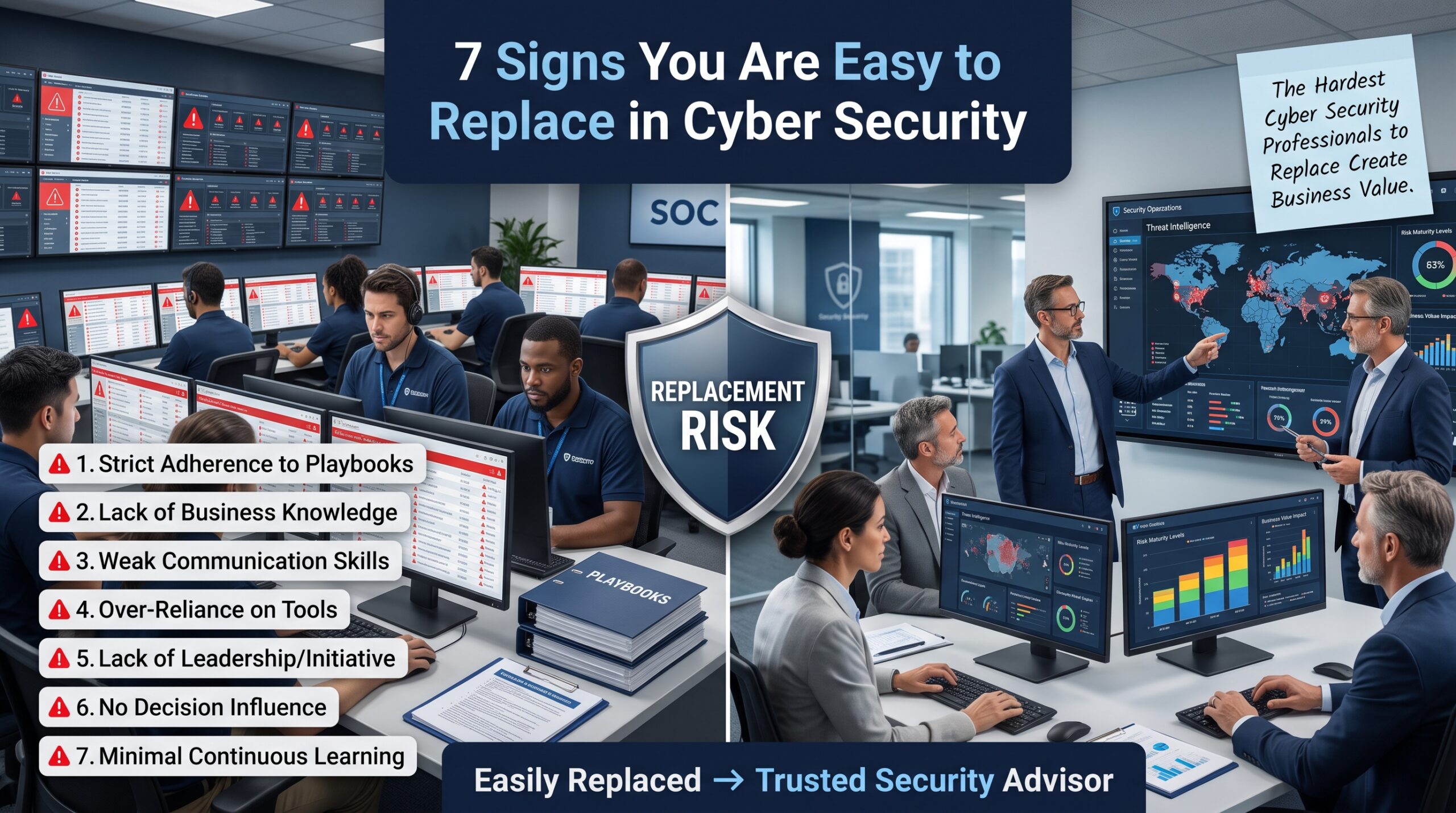
1. Your value is tied to one tool or one certificate
If your whole profile is “Splunk analyst” or “Security+ certified”, you are one platform change or one hiring round away from being compared with a dozen near-identical candidates. Tools and certificates open doors, but they are rarely the reason someone is kept.
2. Most of your work could be scripted or automated
Look at your week. How much is copying alerts, writing the same ticket notes or running the same checks? Repetitive work is exactly where automation lands first. If your role is mostly that, the risk is real, even if you are excellent at it.
3. You do not understand the business risk behind the alerts
A vulnerability is only important in context. Does it affect a system that earns revenue, holds customer data or supports a regulated process? Professionals who can answer that become far more valuable than those who only report technical severity scores.
4. Nobody outside security knows what you do
If leaders, auditors and other teams cannot describe your contribution, you are invisible when decisions about budget and headcount are made. Visibility is not self-promotion. It is making sure the people who decide understand the risk you reduce.
5. You struggle to explain risk to non-technical people
Security leaders spend much of their time translating between technical detail and business language. If you can explain a risk to a finance director or an executive in two clear sentences, you are rare. If you cannot, someone else will be given that conversation, and with it, the promotion.
6. Your learning has stalled
Threats change quickly. If your last significant new skill was three years ago, your knowledge is ageing even if your title is not. Employers can see it in the way you talk about modern topics such as cloud security, identity and AI-assisted attacks.
7. You have few relationships beyond your immediate team
Trust is built across engineering, risk, legal, operations and leadership. Professionals with strong relationships get involved early, shape decisions and are defended when budgets tighten. Those who work in isolation are easy to overlook, and easy to replace.
Easy to Replace vs Indispensable: The Real Difference
Notice that the difference is rarely raw intelligence. It is where you point your skills and how visible the results are.
| Area | Easy to replace | Indispensable |
| Skill profile | Narrow, one tool or one certificate | Broad foundation plus one deep specialty |
| Work type | Repetitive, scriptable tasks | Judgement, investigation and design |
| Business understanding | Reports technical severity | Links risk to revenue, data and regulation |
| Communication | Technical updates only | Explains risk clearly to executives |
| Relationships | Stays inside the security team | Trusted across the organisation |
| Learning | Occasional, reactive | Continuous and planned |
| Visibility | Work is invisible | Impact is known and documented |
Every item in the right-hand column can be learned. That is the encouraging part of the replacement risk, and it means anyone can choose to become indispensable in cyber security.
How to Become Indispensable in Cyber Security: 6 Practical Moves
You do not need to change employers to start. These six moves work inside almost any security role.
- Build a broad foundation, then go deep in one area. Combine core skills such as networking, identity and cloud with a specialty like threat detection, cloud security or incident response.
- Automate your own repetitive work. Learn scripting and use automation to remove routine tasks. Then spend the freed time on harder problems. People who automate themselves into better work rarely get replaced.
- Learn the business. Understand how your organisation makes money, which systems matter most and what regulators expect. This turns technical findings into business priorities.
- Practise plain-English communication. Write short risk summaries, present in team meetings and explain incidents without jargon.
- Document and teach. Write runbooks, mentor juniors and share lessons from incidents. Being the person who raises the whole team is the opposite of being replaceable.
- Build trusted relationships. Meet engineering, legal, risk and finance leads regularly. Understand what keeps them up at night and help with it.
Taken together, these habits are what lead a professional to become indispensable in cyber security, and none of them depend on a particular job title.
Common Mistakes That Stop Professionals Becoming Indispensable
A few well-meaning habits quietly keep people stuck in replaceable roles.
- Collecting certificates without a direction. Five unrelated credentials do less than two that support a clear specialty.
- Hoarding knowledge. Keeping everything in your head feels safe, but it makes you a risk. People who teach and document are valued far more.
- Ignoring soft skills. Technical excellence without communication caps your influence. To become indispensable in cyber security, you need both.
- Waiting to be given opportunities. Volunteer for incident reviews, audits and cross-team projects. That is where trust is built.
- Treating your job description as the limit. The people who become indispensable in cyber security regularly take ownership of problems nobody has assigned.
Certifications That Build Durable, Hard-to-Replace Value
Certifications will not help you become indispensable in cyber security by themselves, but the right ones build the foundation that everything else sits on. Choose them to support a clear direction instead of collecting them.
| Stage | Certification | Why it supports lasting value |
| Foundation | CompTIA Security+ | Core security concepts every employer expects |
| Analyst | CompTIA CySA+ | Threat detection and analysis, moving beyond alert handling |
| Cloud security | Microsoft AZ-500 | Azure security engineering, which is in steady demand |
| Security operations | Microsoft SC-200 | Hands-on Microsoft Sentinel and Defender skills |
| Offensive skills | CompTIA PenTest+ | Understanding attackers makes defenders more effective |
| Leadership | CISM or CISSP | Governance and risk, for senior and management roles |
In Australia, many government and defence roles also require a security clearance, which is a long-term differentiator in its own right. Where relevant, factor it into your career planning early.
A 90-Day Plan to Become Indispensable in Cyber Security
Use this plan alongside your current role. Small, consistent steps compound quickly.
| Phase | Focus | What to do |
| Days 1 to 30 | Audit and automate | List your repeatable tasks and automate the easiest one with a script or workflow. Note the time saved. |
| Days 31 to 60 | Build business context | Meet two leaders outside security. Learn which systems and data matter most. Rewrite one technical report in business language. |
| Days 61 to 90 | Deepen and share | Start a certification or lab in your chosen specialty. Write one runbook and teach it to a colleague. |
After 90 days you will have measurable evidence of impact, a clearer specialty and stronger relationships, which are the building blocks of a hard-to-replace career.
Where Professionals Become Indispensable Across Australian Cities
Local industry shapes which skills help you become indispensable in cyber security in each city.
- Sydney: banking, insurance and fintech reward professionals who combine technical depth with risk and compliance understanding.
- Melbourne: health, retail and technology organisations value cloud security and identity skills alongside strong communication.
- Brisbane and the Gold Coast: growing infrastructure, government and managed services teams need analysts who can work across IT and operations.
- Perth: resources and energy companies prize people who understand operational technology (OT) and industrial environments.
- Adelaide: defence and advanced manufacturing create demand for professionals who can work in controlled, high-assurance settings.
- Canberra: federal government roles favour cleared professionals with governance, policy and risk expertise.
For a structured view of cyber security skills and roles, the NIST NICE Framework is a helpful external reference for planning your development.
Cyber Security Courses That Help You Stand Out
Structured training saves time, fills gaps and gives employers a recognised signal as you work to become indispensable in cyber security. These are the pathways Australian professionals ask about most.
- CompTIA Security+ and CySA+: the core foundation and analyst pathway. Explore our cyber security certifications.
- Microsoft AZ-500 and SC-200: cloud and security operations skills that stay in demand. See Azure certifications and the full cyber security courses.
- CompTIA PenTest+: an offensive perspective that sharpens your defensive thinking.
- Wider IT training: browse the complete catalogue at Logitrain.
If you are unsure which pathway fits your current role, our team can help you map it to your goals.
Quick Self-Audit: How Replaceable Are You?
Answer honestly. Each “no” is a place to focus first.
- Is your skill set broader than a single tool or certificate?
- Have you automated at least one repetitive part of your work?
- Can you explain the business impact of your top three security risks?
- Could a non-technical executive describe what you contribute?
- Have you learned a significant new skill in the last 12 months?
- Do you have trusted relationships outside the security team?
If you answered no to three or more, your replacement risk is higher than it needs to be, and the 90-day plan above is your starting point.
Frequently Asked Questions
How do you become indispensable in cyber security?
To become indispensable in cyber security, build a broad foundation with one deep specialty, automate your repetitive work, learn the business, communicate clearly and build trust across the organisation. Certifications support this, but impact and judgement matter most.
Will AI replace cyber security professionals?
AI is automating routine tasks such as alert triage and summarisation, so purely repetitive roles face more pressure. Professionals who bring judgement, business context and communication are far more likely to benefit from AI than be replaced by it.
Are certifications enough to secure my career?
No. Certifications open doors and prove knowledge, but employers keep and promote people who solve problems and reduce real risk. Pair credentials with hands-on experience and visible results.
Which cyber security skills are hardest to replace?
Incident response judgement, cloud and identity security design, threat hunting, risk communication and the ability to link technical findings to business priorities. These rely on context and trust, not just tools.
How long does it take to become indispensable?
You can build visible momentum in 90 days, but to become indispensable in cyber security as a trusted, hard-to-replace professional usually takes a few years of deliberate skill-building and relationship-building.
Make Yourself the Professional They Cannot Easily Replace
The replacement risk is not a threat to be feared. It is a signal showing where to invest. Move away from narrow, repeatable work and towards judgement, context and trust, and you will find it much easier to become indispensable in cyber security.
Ready to take the next step? Explore our cyber security certifications, look at the wider cyber security course range, or browse everything on offer at Logitrain.