


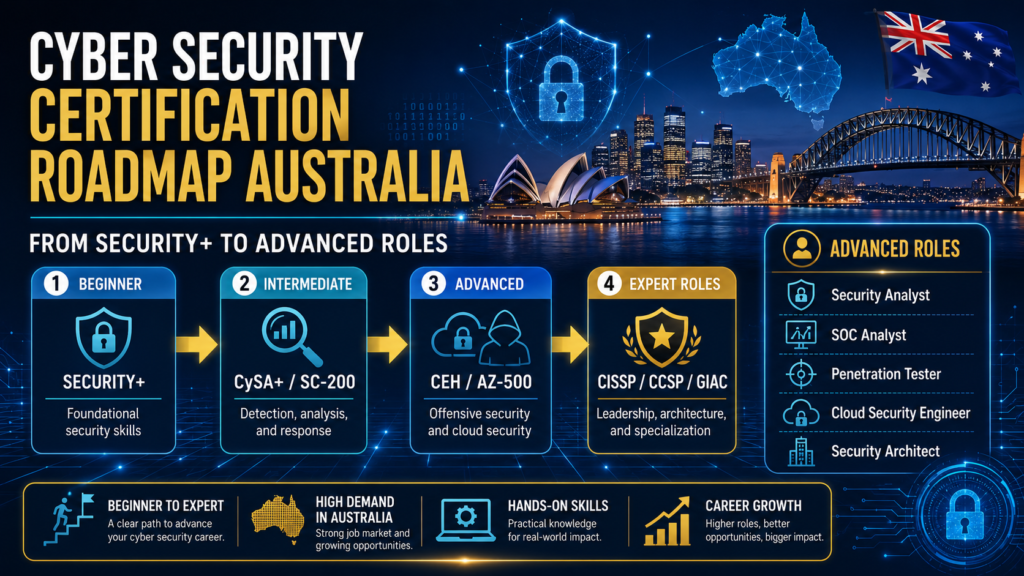
The cyber security certification roadmap Australia professionals actually follow isn’t one straight line it’s a foundation, followed by a fork toward whichever role genuinely interests you. Nearly everyone starts in the same place, then branches toward SOC and detection work, penetration testing, network security, or incident response, before some eventually move into consultant-level roles that draw on all of it. This guide walks through that roadmap properly: what to get first, how the fork works, and which certifications support which job titles.
If you’ve been comparing acronyms and wondering where you actually fit—SOC analyst, penetration tester, network security analyst—this guide maps the path role by role rather than certification by certification. To get personalised advice on the best cyber security training and certification pathway for your career goals, contact us on 1800 159 151 and speak with our team of learning experts.
How the Cyber Security Certification Pathway Works in Australia
Most Australian cyber security job ads assume a layered set of skills rather than a single credential. Employers want a broad security foundation first, then evidence of depth in one specific area detection, offensive testing, network infrastructure, or incident handling. The certification pathway Australia’s training providers teach mirrors that structure: one foundation certification, one specialisation certification, and increasingly, role-specific experience layered on top of both.
Step 1: Start With a Foundation CompTIA Security+
CompTIA Security+ Australia remains the standard first cyber security certification for beginners, and for good reason it’s vendor-neutral, broadly recognised, and covers the core concepts (networks, threats, cryptography, security operations) that every specialisation below assumes you already understand. Full details sit on CompTIA’s official Security+ certification page. If you’re asking how to start a cyber security certification in Australia with zero background, this is genuinely the answer almost every training provider will give you.
Step 2: Choose Your Specialisation Track
Once Security+ (or an equivalent beginner cyber security course) is done, the roadmap splits into a few well-worn tracks. None is objectively “better” the right one depends on which work you’d actually enjoy doing five days a week.
SOC Analyst Roadmap Australia: Detection and Response
If monitoring, triage and investigating alerts sounds like your kind of work, the SOC analyst roadmap Australia typically runs Security+ into CompTIA CySA+ Australia, a threat detection certification focused on monitoring, log analysis and incident triage. This is the clearest path into a SOC analyst certification Australia employers ask for, and it pairs naturally with a security analyst certification Australia track more broadly. Full CySA+ details are on CompTIA’s official CySA+ certification page.
Penetration Tester Roadmap Australia: Offensive Security
If you’d rather find and exploit weaknesses before attackers do, the penetration tester roadmap Australia moves from Security+ into CompTIA PenTest+ Australia, a penetration testing certification covering methodology, tools and reporting for an ethical hacking certification Australia pathway. Details are on CompTIA’s official PenTest+ certification page. This track suits people who enjoy a more investigative, adversarial style of work over the monitoring-heavy SOC path.
Network Security Analyst Roadmap Australia: Infrastructure-Focused
If your interest sits closer to firewalls, network segmentation and infrastructure hardening, a network security certification path built around PCNSA certification Australia (Palo Alto Networks Certified Network Security Administrator) is a strong, vendor-specific option once Security+ is in place. Palo Alto Networks’ platform is widely deployed across Australian enterprise and government networks, which makes a Palo Alto cyber security certification Australia a genuinely practical credential for a network security analyst certification Australia pathway specifically, rather than a general-purpose add-on.
Step 3: Build Toward Incident Response and Consultant-Level Roles
Once you’ve got a foundation certification plus one specialisation under your belt, two further directions open up. An incident response analyst certification Australia pathway builds on the SOC/CySA+ track, adding deeper forensics and structured incident-handling process on top of general detection skills. A cyber security consultant certification Australia pathway tends to come later still, once you’ve built breadth across detection, offensive testing and network security combined with several years of real client- or organisation-facing experience consulting roles lean as much on communication and business context as on any single technical certification.
Career Roadmaps by Job Title
- SOC Analyst Security+ → CySA+ → real SOC experience → optional incident response specialisation.
- Security Analyst Security+ → CySA+ or PenTest+ depending on whether the role leans defensive or offensive.
- Penetration Tester / Ethical Hacker Security+ → PenTest+ → hands-on lab practice and CTF experience → optional CEH.
- Network Security Analyst Security+ → PCNSA (or equivalent vendor certification) → hands-on firewall and network infrastructure experience.
- Incident Response Analyst Security+ → CySA+ → structured incident response and forensics training.
- Cyber Security Consultant broad experience across the above tracks, typically several years in, often layered with a business- or governance-focused credential later.
Cyber Security Certification Training Across Melbourne, Sydney, Brisbane, Adelaide, Canberra and Perth
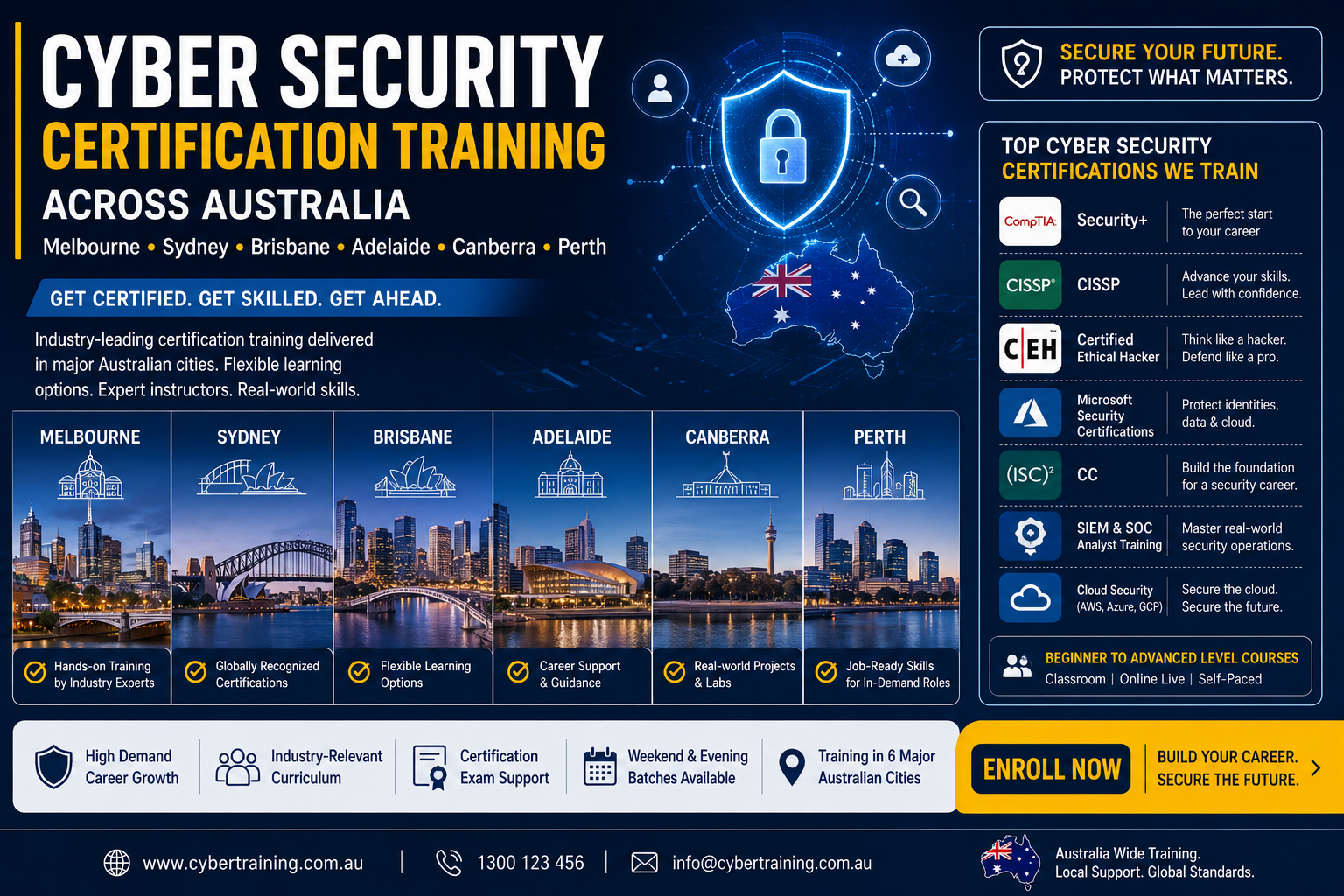
At Cyber Security Certifications Australia, training follows this exact roadmap a beginner cyber security course Australia through to CySA+, PenTest+ and PCNSA preparation, mapped to the career path you’re actually aiming for.
- Cyber security certification Melbourne and cyber security training Melbourne foundation through specialisation pathways, in person and live online.
- Cyber security certification Sydney and cyber security course Sydney Security+, CySA+ and PenTest+ preparation for Sydney’s finance and consulting-heavy employer base.
- Cyber security certification Brisbane and cyber security training Brisbane foundational and SOC-track pathways for Brisbane’s growing government and tech sector demand.
- Cyber security certification Adelaide and cyber security course Adelaide including defence-adjacent pathways relevant to Adelaide’s expanding defence industry.
- Cyber security certification Canberra and cyber security course Canberra public sector-aligned training given Canberra’s concentration of federal agencies.
- Cyber security certification Perth and cyber security course Perth training aligned to Perth’s resources-sector infrastructure and network security needs.
Every city also has online cyber security certification Australia and live online cyber security course Australia options, so the roadmap above is achievable no matter where you’re based.
Choosing Between Online, Live Online and Instructor-Led Training
A cyber security course with certificate Australia delivered fully online and self-paced works well if you’re fitting study around a current job. Instructor led cyber security training Australia whether in person or live online suits people who want a fixed pace, direct access to a trainer, and accountability toward an actual exam date. Cyber security exam preparation Australia support (practice exams, structured revision) is worth checking for either format, since it’s often the difference between finishing a course and actually sitting the certification exam.
Cyber Security Certification Roadmap Australia: Frequently Asked Questions
What is the first cyber security certification I should get in Australia?
CompTIA Security+ is the standard first step for almost everyone. It’s vendor-neutral, widely recognised across Australian employers, and treated as prior knowledge by nearly every certification that follows it.
How do I know whether to follow the SOC analyst or penetration tester roadmap?
Think about the actual daily work rather than the job title. SOC and CySA+ work is largely monitoring, investigating alerts and responding to incidents steady, detail-focused work. Penetration testing and PenTest+ work is more exploratory and adversarial actively looking for weaknesses. Most people have a clear preference once they picture the daily reality of each.
Is PCNSA worth getting if I already have Security+?
Yes, if network security specifically interests you or you’re targeting organisations running Palo Alto Networks infrastructure common across Australian enterprise and government networks. It’s a more specialised, vendor-specific step rather than a replacement for a broader foundation certification.
Can I skip Security+ and go straight to CySA+ or PenTest+?
Technically yes, but it’s not recommended for most beginners. Both certifications assume the foundational knowledge Security+ covers, and skipping it usually means more struggle during study rather than any real time saved.
How long does the full roadmap take from beginner to specialised role?
Most people following a structured cyber security certification pathway Australia Security+, then a specialisation reach a genuinely job-ready standard for entry-level roles in six to twelve months of consistent study, with real hands-on practice alongside the certifications themselves speeding up how quickly that knowledge becomes usable on the job.
Do I need a university degree as well as these certifications?
Not necessarily. Many Australian cyber security professionals move into SOC analyst, security analyst and network security roles through certifications and hands-on practice home labs, capture-the-flag exercises, entry-level IT support roles rather than a dedicated degree. A degree can help for graduate programs at larger organisations, but it isn’t a strict requirement for most of the roadmap above.
What comes after CySA+, PenTest+ or PCNSA?
It depends on the direction you want to keep building in: deeper incident response and forensics training for the SOC/CySA+ track, more advanced offensive certifications for the PenTest+ track, or further vendor-specific network certifications for the PCNSA track. Eventually, broad experience across more than one of these tracks is what supports a move into cyber security consultant certification Australia territory.
Final Thoughts
The cyber security certification roadmap Australia actually follows comes down to a foundation, a fork, and then depth: Security+ first, then CySA+, PenTest+ or PCNSA depending on whether detection, offensive testing or network infrastructure genuinely interests you, followed by real hands-on experience in that specific direction. Pick the track that matches the daily work you’d actually want to do, choose a cyber security course Australia program built around that exact pathway, and the roadmap above becomes a lot less overwhelming than the certification list looks on its own.