


Microsoft Sentinel vs Splunk is a question almost every aspiring SOC analyst in Australia eventually asks, because job ads rarely specify just one. Both are leading SIEM (Security Information and Event Management) platforms used to detect, investigate and respond to threats, and both regularly appear side by side in Australian cyber security job listings. This guide compares Microsoft Sentinel and Splunk so you can decide which platform to learn first, based on real job demand and how each one fits into a certification pathway.
Choosing between Microsoft Sentinel vs Splunk matters less than most beginners think what matters more is pairing whichever tool you choose with recognised cyber security certification training that gives the SIEM skills real context.
What Is a SIEM, and Why Does It Matter for a Cyber Security Career?
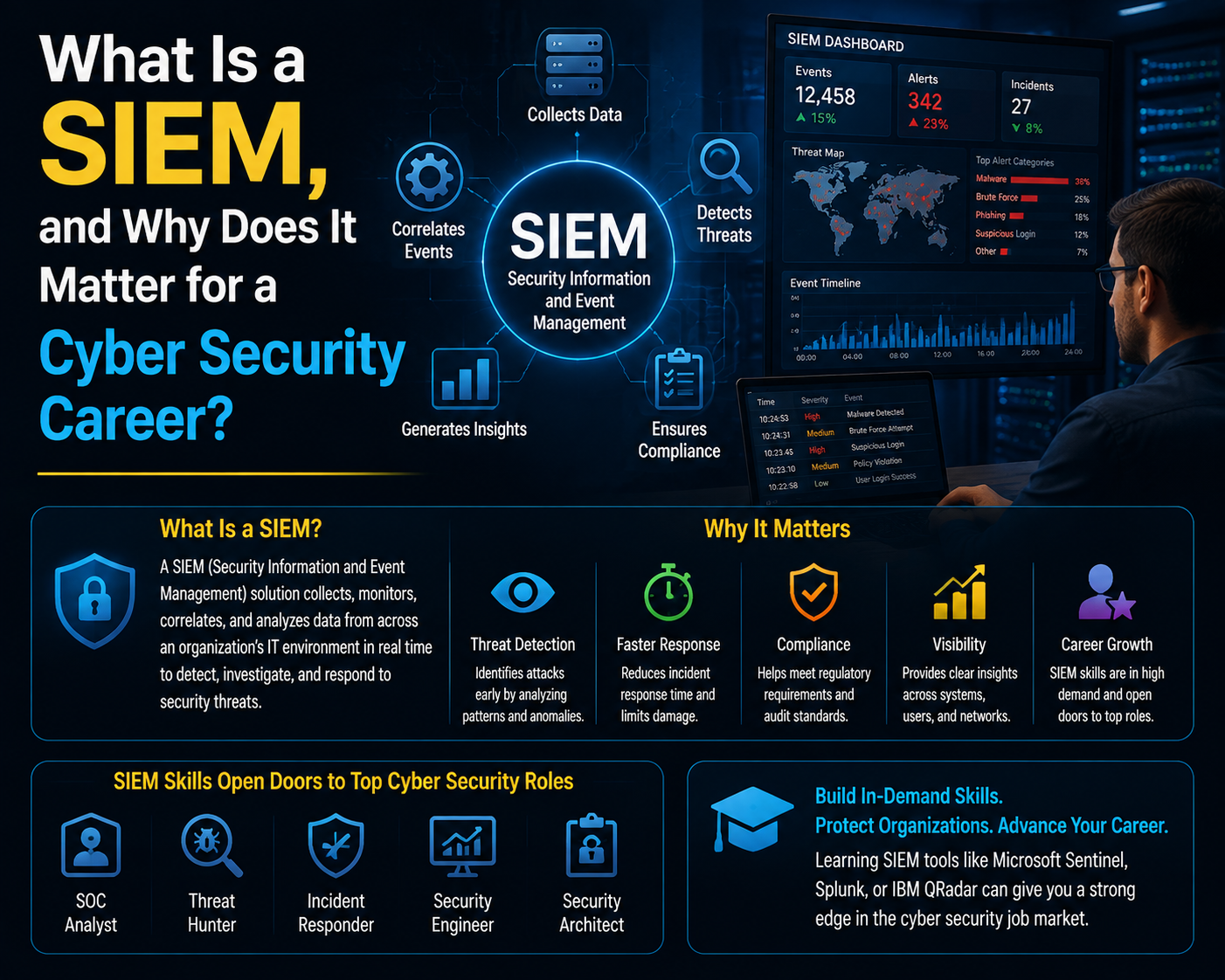
A SIEM platform collects log and event data from across an organisation’s systems, network and cloud services, then correlates it to detect suspicious activity in near real time. SOC analysts, threat hunters and incident responders spend a large part of their day working inside a SIEM, which is why hands-on SIEM experience is one of the most requested skills in entry-level and mid-level cyber security job ads across Australia.
What Is Microsoft Sentinel?
Microsoft Sentinel is a cloud-native SIEM and SOAR (Security Orchestration, Automation and Response) platform built on Azure. It uses Kusto Query Language (KQL) to search and analyse data, integrates tightly with Microsoft 365, Azure and Microsoft Defender, and is increasingly the default choice for organisations already invested in the Microsoft ecosystem.
What Is Splunk?
Splunk is one of the longest-established SIEM platforms, widely used across large enterprises, government and organisations with high volumes of diverse log data. It uses its own Search Processing Language (SPL) and is known for its powerful, flexible dashboards and its large third-party app ecosystem.
Microsoft Sentinel vs Splunk: Full Comparison
| Factor | Microsoft Sentinel | Splunk |
| Deployment | Cloud-native, built on Azure | On-premises or cloud (Splunk Cloud) |
| Query language | Kusto Query Language (KQL) | Search Processing Language (SPL) |
| Best fit | Organisations already using Microsoft 365 and Azure | Large enterprises and organisations with varied, high-volume log sources |
| Pricing model | Pay-as-you-go, based on data ingested | Licensing based on data volume or workload |
| Learning cost | Free Azure trial and Microsoft Learn sandboxes available | Free Splunk trial and a free single-user license for practice |
| Related certification | Microsoft SC-200 / AZ-500 | Splunk Core Certified User / Power User |
Which Is Easier to Learn?
Most beginners find Microsoft Sentinel a little more approachable if they’ve already had exposure to Microsoft 365 or Azure, since KQL is closely related to SQL-style querying and the interface reflects other Microsoft admin tools. Splunk’s SPL has a steeper initial learning curve but is extremely powerful once learned, and its free single-user licence makes it easy to practise on real data at home.
Which Has Better Job Demand in Australia?
Both platforms show up consistently across Australian SOC analyst, security engineer and threat detection job ads. Splunk has a longer history in large enterprise and government environments, so it still appears heavily in bigger organisations’ listings. Microsoft Sentinel demand has grown quickly alongside broader Microsoft 365 and Azure adoption, particularly in mid-sized Australian businesses migrating to the cloud. In practice, many SOC teams run both, so job ads increasingly list either platform as acceptable experience rather than a strict requirement.
Which Should You Learn First?
Learn Microsoft Sentinel First If…
- You’re already working toward Microsoft certifications like SC-200 or AZ-500
- Your target employer runs primarily on Microsoft 365 and Azure
- You want the fastest path to a usable, free practice environment
Learn Splunk First If…
- You’re targeting large enterprise, government, or multi-vendor security environments
- You want a widely transferable skill that shows up in SOC job ads regardless of the employer’s cloud platform
- You’re comfortable investing more time upfront in a steeper learning curve
For most people starting a SOC-focused cyber security career in Australia, the practical answer is: learn the fundamentals of both, but go deep on one. A strong foundation in CompTIA CySA+ or CompTIA Security+ builds the detection and analysis fundamentals that transfer directly to either SIEM platform.
How to Start Learning Each Platform
Getting Started with Microsoft Sentinel
Microsoft provides free, guided Sentinel learning paths and sandbox environments through Microsoft Learn, and Sentinel skills build naturally on top of the foundations covered in our AZ-500 course.
Getting Started with Splunk
Splunk offers a free single-instance licence and its own guided tutorials through Splunk’s official training resources, which is enough to build genuine hands-on experience searching and visualising sample security data.
Build Your SOC Career With the Right Certifications
SIEM tool skills are most valuable when they sit on top of solid cyber security fundamentals. Our instructor-led CompTIA Security+ course builds the foundational knowledge SOC roles expect, while CompTIA CySA+ goes deeper into threat detection and analysis the exact skills you’ll apply inside Sentinel or Splunk daily. If your target role is Microsoft-focused, our AZ-500 course covers Azure security engineering, which pairs naturally with Sentinel.
We deliver this training across Melbourne, Sydney, Brisbane, Perth, Adelaide and Canberra, both in person and live online. If you’re comparing certification paths more broadly, our guide on CompTIA Security+ vs CySA+ is a useful next read, or you can get in touch to find the right starting point for your background.
Frequently Asked Questions
Do I need to know coding to use Microsoft Sentinel or Splunk?
No traditional coding is required. Both use their own query languages (KQL for Sentinel, SPL for Splunk), which are learned through practice rather than a programming background.
Is Splunk or Microsoft Sentinel better for beginners?
Microsoft Sentinel is often slightly easier to pick up if you already understand Microsoft 365 or Azure basics, but both platforms are learnable by complete beginners with consistent, hands-on practice.
Which certification pairs best with Microsoft Sentinel?
Microsoft’s SC-200 and AZ-500 certifications pair most directly with Sentinel, since both cover Azure-based security operations. Our AZ-500 course is a strong foundation.
Can I learn both Microsoft Sentinel and Splunk?
Yes, and many working SOC analysts do, since different employers run different platforms. Building fundamentals in one first, then adding the second, is the most common and manageable approach.
Conclusion
Microsoft Sentinel vs Splunk isn’t really a competition with one winner both are widely used across Australian security operations centres, and the right choice depends on the environment you want to work in. Start with strong cyber security fundamentals, then choose the platform that matches your target employer or industry. Explore our cyber security certification courses to build that foundation, or read more on our blog for more Australian cyber security career comparisons.