


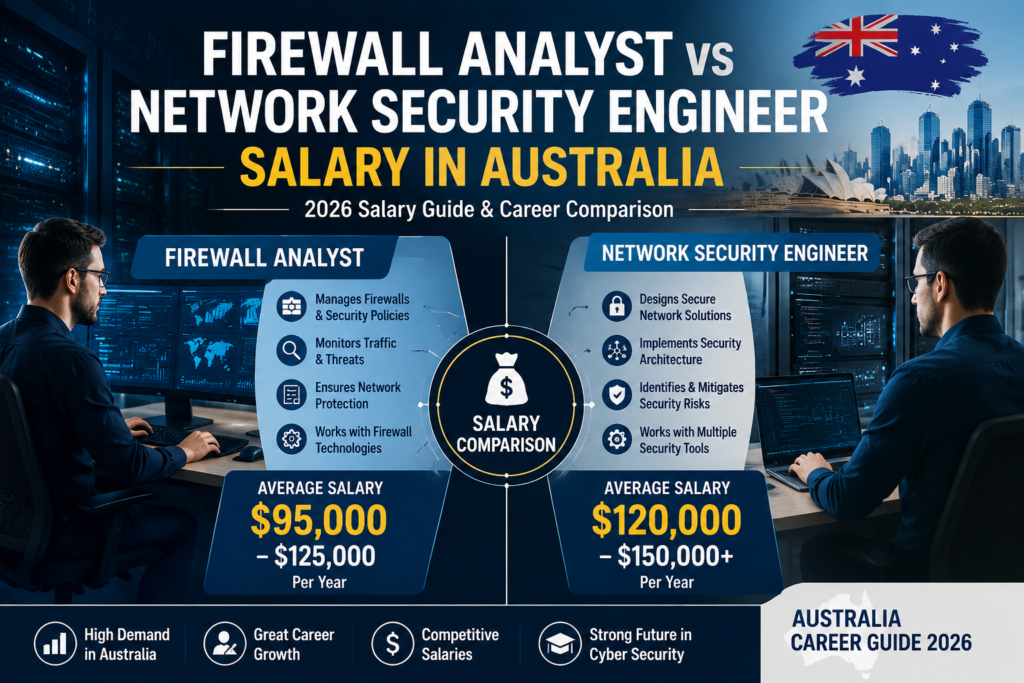
If you’re weighing up a Firewall Analyst Network Security Engineer salary Australia comparison before you commit to a certification or a career move, you’re not alone. Organisations across Sydney, Melbourne, Brisbane, Perth, Adelaide and Canberra are all hunting for people who can secure networks, manage firewall policies, monitor traffic, support VPNs, troubleshoot incidents and keep hybrid and cloud environments protected. Demand hasn’t slowed down if anything, it’s spread further as more businesses move workloads to the cloud and lean on SASE and Zero Trust architectures.
A lot of learners still search for PCNSA, and it’s easy to see why it was the go-to entry point into Palo Alto Networks for years. But in 2026, it’s worth pausing before you book that exam. Palo Alto Networks’ official certification page now lists role-based certifications across Network Security, Security Operations and Cloud Security, including Network Security Analyst and Next-Generation Firewall Engineer. (paloaltonetworks.com) This guide walks through current salary ranges, what each role actually involves, and where PCNSA fits into the bigger picture.
Quick Answer: Is PCNSA Worth It in Australia in 2026?
If you already hold PCNSA, hang onto it it still demonstrates genuine Palo Alto firewall knowledge and plenty of employers still recognise the name. If you’re starting from scratch in 2026, though, check Palo Alto Networks’ current certification portfolio before you begin studying, because the official pathway now points toward newer role-based certifications such as Network Security Analyst and Next-Generation Firewall Engineer.
Palo Alto Networks’ current certification program is structured around levels Foundational, Professional, Specialist and Architect — with Network Security certifications built for people working with Palo Alto Networks firewalls, SASE, SD-WAN and security operations. (paloaltonetworks.com) (pearsonvue.com)
What Does a Firewall Analyst Do?
A Firewall Analyst is the person keeping day-to-day watch over an organisation’s firewall estate — reviewing rules, monitoring logs and making sure access requests don’t quietly turn into security gaps. It’s a hands-on, detail-focused role that suits people who like structure and don’t mind digging through logs to find the root cause of a problem.
Typical Firewall Analyst responsibilities include:
- Reviewing firewall rules
- Creating and modifying security policies
- Monitoring firewall logs
- Investigating blocked or suspicious traffic
- Supporting VPN access
- Troubleshooting connectivity issues
- Managing NAT policies
- Escalating security incidents
- Supporting network segmentation
- Documenting firewall changes
This role sits at the entry-to-mid level for most Australian employers, and it’s a common launchpad into broader network security careers.
What Does a Network Security Engineer Do?
A Network Security Engineer usually carries broader responsibility than a Firewall Analyst. The role can stretch across firewall deployment, secure network design, VPNs, routing, switching, segmentation, cloud connectivity, monitoring and security hardening — essentially, building and defending the network rather than just watching it.
PayScale describes Network Security Engineers as professionals involved in the provisioning, deployment, configuration and administration of network and security hardware and software, including firewalls, routers, switches, monitoring tools and VPNs. (payscale.com)
Typical Network Security Engineer responsibilities include:
- Designing secure network architectures
- Deploying and configuring firewalls
- Managing VPNs and remote access
- Implementing network segmentation
- Troubleshooting security incidents
- Maintaining security appliances
- Integrating firewalls with SIEM tools
- Supporting cloud and hybrid network security
- Managing high availability firewall clusters
- Working with vendors and managed service providers
Firewall Analyst vs Network Security Engineer: What’s the Difference?
In short: a Firewall Analyst focuses more on firewall monitoring, rule reviews, logs and access requests, while a Network Security Engineer focuses more on design, implementation, troubleshooting and advanced network security infrastructure. Neither is “better” they’re different stages of the same career path, and most Network Security Engineers started out doing Firewall Analyst-style work.
| Role | Main Focus | Typical Level | Common Tools |
|---|---|---|---|
| Firewall Analyst | Firewall rules, logs, policies and access requests | Junior to mid-level | Palo Alto, Fortinet, Check Point, SIEM |
| Network Security Engineer | Secure network design, firewall deployment, VPNs, troubleshooting | Mid to senior-level | Palo Alto, Cisco, Fortinet, VPN, routing, SIEM |
| Firewall Engineer | Firewall design, migration, tuning and advanced operations | Mid to senior-level | Palo Alto NGFW, Panorama, FortiGate, Check Point |
Firewall Analyst and Network Security Engineer Salary in Australia in 2026

Salaries in this space vary a lot depending on experience, location, security clearance, industry, vendor stack, and whether the role is permanent or contract. A Firewall Analyst in a Sydney bank will typically earn more than one in a regional managed service provider, and a Network Security Engineer with an active government clearance in Canberra can out-earn a similarly experienced engineer in the private sector elsewhere.
Rough salary ranges to expect in 2026:
- Firewall Analyst: AUD $85,000 – $120,000
- Network Security Engineer: AUD $100,000 – $150,000+
- Senior Network Security Engineer: AUD $140,000 – $170,000+
- Contract security/network roles: often quoted as daily rates
SEEK’s 2026 data shows Information & Communication Technology Network Engineer roles averaging around $126,045, with Government & Defence roles also sitting strongly at around $120,107. (au.seek.com)
PayScale lists the average Network Security Engineer salary in Australia at about AU$92,500, with a range around AU$79k–AU$122k, based on a smaller salary sample. (payscale.com)
SalaryExpert reports a noticeably higher 2026 average base salary for Network Security Engineer roles in Australia — around $150,566, with senior-level estimates above $170,000. (salaryexpert.com)
The spread between these sources is a good reminder that salary sites use different sample sizes and methods — treat any single figure as a guide, not gospel, and cross-check against current job ads in your city.
Why Salaries Vary So Much in Australia
Experience Level
Junior analysts tend to focus on rule changes and monitoring, while senior engineers design secure architectures, manage migrations and troubleshoot complex, multi-vendor incidents. That gap in scope is the biggest single driver of salary difference.
Location
Where you’re based matters. The major Australian markets for firewall and network security roles are Sydney, Melbourne, Brisbane, Canberra, Perth and Adelaide. Sydney and Melbourne generally carry the largest volume of roles thanks to financial services and enterprise head offices, Canberra pays a premium for cleared government work, Perth and Brisbane have strong demand tied to resources, energy and government contracts, and Adelaide’s defence and space sector is growing its own pocket of network security hiring.
Security Clearance
Canberra and other government-related roles often pay more when they require Australian citizenship and a Baseline, NV1, NV2 or TSPV clearance — clearance alone can add a meaningful premium on top of the base technical salary.
Vendor Skills
High-value vendor skills currently include:
- Palo Alto Networks
- Fortinet
- Cisco
- Check Point
- Zscaler
- Prisma Access
- Microsoft Sentinel
- Splunk
Contract vs Permanent Roles
Contract roles often pay a higher day rate, but permanent roles usually come with superannuation, leave, training budgets and a clearer path for career progression — worth weighing up beyond the headline number.
Is Palo Alto Firewall Knowledge Valuable in Australia?
Yes. Palo Alto firewall knowledge is valuable because a large share of Australian organisations — across government, financial services, healthcare and telecommunications — run Palo Alto Next-Generation Firewalls, SASE, VPNs and network segmentation to protect hybrid environments.
Palo Alto Networks’ current certification portfolio includes network security credentials for people who want to demonstrate their knowledge of network security, including the implementation and administration of Palo Alto Networks Next-Generation Firewalls and SASE technologies. (paloaltonetworks.com)
What Happened to PCNSA?
PCNSA was widely known as the Palo Alto Networks Certified Network Security Administrator certification. But in 2026, learners shouldn’t assume it’s still the best or most current path. Palo Alto Networks now promotes a role-based certification portfolio, with credentials such as Network Security Analyst and Next-Generation Firewall Engineer taking its place at the centre of the program.
Pearson VUE’s Palo Alto Networks exam page lists current certification categories such as Network Security Analyst, Security Service Edge Engineer, SD-WAN Engineer, Next-Gen Firewall Engineer, XSIAM Analyst, XSOAR Engineer and XDR Engineer. (pearsonvue.com) Palo Alto Networks’ own certification page also organises the portfolio into Foundational, Professional, Specialist and Architect levels across platform areas such as Network Security, Security Operations and Cloud Security. (paloaltonetworks.com)
PCNSA vs New Palo Alto Certifications in 2026
If your search intent was originally built around PCNSA, it’s worth redirecting that effort toward the current Palo Alto Networks lineup instead.
If You Are a Beginner
Consider:
- Cybersecurity Apprentice
- Cybersecurity Practitioner
- Network Security Professional
If You Want Firewall Analyst Roles
Consider:
- Network Security Analyst
- Next-Generation Firewall Engineer
If You Want Advanced Firewall Engineering Roles
Consider:
- Next-Generation Firewall Engineer
- Network Security Architect
Palo Alto Networks describes Network Security Analyst as validating technical knowledge and skills in firewall configuration, subscriptions, management and operations in a network security environment. It describes Next-Generation Firewall Engineer as validating knowledge and skills in PAN-OS networking, device configuration, integration, automation and centralised management using Panorama, templates and rulesets. (paloaltonetworks.com)
What Skills Do Employers Expect from Firewall Analysts?
Firewall Policy Management
- Security policy rules
- Source and destination zones
- Applications and services
- Address objects
- Rule order
- Least privilege access
- Policy cleanup
Network Fundamentals
- TCP/IP
- Routing
- Switching
- DNS
- NAT
- VLANs
- Subnets
- VPNs
- Load balancing basics
Log Analysis and Troubleshooting
Being able to read a firewall log quickly, spot a genuine threat versus noise, and trace a connectivity problem back to its cause is one of the most valued day-to-day skills in this role.
Security Controls
- URL filtering
- Threat prevention
- Antivirus profiles
- Anti-spyware profiles
- Vulnerability protection
- WildFire
- SSL inspection awareness
Documentation and Change Control
- Firewall rule documentation
- Change requests
- Implementation plans
- Rollback plans
- Audit evidence
- Approvals
What Skills Do Employers Expect from Network Security Engineers?
Advanced Firewall Administration
- Palo Alto NGFW
- Panorama
- FortiGate
- Check Point
- High availability
- Firewall migrations
- Policy optimisation
VPN and Remote Access
- IPsec VPN
- SSL VPN
- GlobalProtect
- Site-to-site VPN
- Remote access troubleshooting
- Authentication integration
Network Security Architecture
- Zero Trust
- Segmentation
- DMZ design
- Hybrid cloud connectivity
- Private access
- SASE
- Secure internet gateway
Monitoring and Incident Response
- SIEM integration
- SOC escalations
- Threat investigation
- Incident response support
- Packet captures
- Root cause analysis
Automation and Cloud Awareness
- API basics
- Python basics
- Infrastructure as Code awareness
- Azure networking
- AWS networking
- Cloud firewalls
- SASE platforms
Best Certifications for Firewall and Network Security Careers
Palo Alto Networks Certifications
- Network Security Analyst
- Next-Generation Firewall Engineer
- Network Security Professional
- Network Security Architect
Palo Alto Networks’ official certification program now lists role-based credentials across Network Security, Security Operations and Cloud Security, including Network Security Analyst and Next-Generation Firewall Engineer. (paloaltonetworks.com)
Cisco Certifications
- CCNA
- CCNP Enterprise
- CCNP Security
Fortinet Certifications
- Fortinet Certified Fundamentals
- Fortinet Certified Associate
- Fortinet Certified Professional
General Cybersecurity Certifications
- CompTIA Network+
- CompTIA Security+
- CompTIA CySA+
- CompTIA PenTest+
- CISSP
Recommended Career Path in Australia
Beginner Path
- IT Support
- Network fundamentals
- CompTIA Network+ or CCNA
- Basic firewall administration
- Junior Firewall Analyst
Firewall Analyst Path
- Network support
- Palo Alto or Fortinet firewall training
- Firewall rule management
- Log analysis
- Change control
- Firewall Analyst
Network Security Engineer Path
- Network Engineer
- Firewall administration
- VPN and segmentation
- SIEM integration
- Palo Alto / Fortinet / Cisco security certification
- Network Security Engineer
Advanced Path
- Senior Network Security Engineer
- Security Architect
- Cloud Security Engineer
- SASE Architect
- Network Security Architect
Is PCNSA Enough to Get a Job?
On its own, usually not. Employers typically want hands-on firewall experience, solid networking fundamentals, real troubleshooting ability, documentation skills, and concrete examples of change control or incident response not just an exam pass.
Jobs and Skills Australia defines ICT Security Specialists as professionals who manage ICT security policies, procedures, preventive strategies and recovery strategies, which is a good reminder that candidates need to show practical ability beyond certification theory. (jobsandskills.gov.au)
Portfolio Projects to Build Practical Firewall Skills
A few projects that genuinely help at interview stage:
- Create a home lab with pfSense or virtual firewall tools
- Document firewall rule change examples
- Build a sample network diagram
- Practise reading firewall traffic logs
- Create a VPN troubleshooting checklist
- Write a firewall audit report
- Document a security policy cleanup project
- Create a basic incident investigation report
- Build a SIEM-style log analysis example
Common Mistakes to Avoid
- Studying PCNSA without checking whether it is still current
- Ignoring networking fundamentals
- Learning firewall theory without hands-on labs
- Not practising troubleshooting
- Not documenting changes properly
- Ignoring NAT and routing
- Only learning one vendor
- Not understanding SIEM and SOC workflows
- Applying for senior engineering roles too early
Final Verdict: Is PCNSA Worth It in 2026?
PCNSA may still hold some value as a recognised name and a legacy Palo Alto firewall credential, especially if you already hold it or if job ads in your area still mention it specifically. But if you’re starting fresh in 2026, the smarter move is to check Palo Alto Networks’ current certification portfolio and choose the newer role-based certification that actually matches your target role.
For Firewall Analyst roles, focus your study on firewall policy management, logs, NAT, VPNs, security profiles and change control. For Network Security Engineer roles, go deeper into routing, segmentation, high availability, Panorama, SASE, cloud networking and troubleshooting.
Wherever you land in the Firewall Analyst Network Security Engineer salary Australia range, the pattern across Sydney, Melbourne, Brisbane, Perth, Adelaide and Canberra is consistent: Palo Alto firewall skills are valuable, but the best outcomes come from pairing current certification with hands-on experience, solid networking knowledge and practical security operations skills.
FAQs About Firewall Analyst / Network Security Engineer Salary and PCNSA in Australia
What is the salary of a Firewall Analyst in Australia?
Firewall Analyst salaries commonly vary by experience, but many roles sit around AUD $85,000–$120,000, depending on location, vendor skills and security clearance.
What is the salary of a Network Security Engineer in Australia?
Network Security Engineer salary data varies by source. PayScale lists an average around AU$92,500, while SalaryExpert reports a higher average around $150,566 for 2026. (payscale.com), (salaryexpert.com)
Is PCNSA still worth it in 2026?
It can still be useful if employers recognise it, but new learners should verify the current Palo Alto Networks certification path first, since the official program now highlights role-based certifications such as Network Security Analyst and Next-Generation Firewall Engineer. (paloaltonetworks.com), (pearsonvue.com)
What certification should I do instead of PCNSA?
For firewall-focused roles, look at current Palo Alto Networks certifications such as Network Security Analyst or Next-Generation Firewall Engineer, depending on your experience level and target job.
Do I need networking knowledge before learning Palo Alto firewalls?
Yes. Firewall roles require solid networking fundamentals such as TCP/IP, routing, switching, NAT, DNS, VPNs, subnets and troubleshooting before firewall-specific concepts really click.
Which is better: Firewall Analyst or Network Security Engineer?
Firewall Analyst tends to suit entry-level to mid-level firewall operations work. Network Security Engineer suits people who want broader responsibility, stronger salary potential and more advanced infrastructure work.
Call To Action
Want to move into firewall or network security roles in Australia?
Start with networking fundamentals, build hands-on firewall skills, then choose a current Palo Alto Networks certification that matches your career goal.