


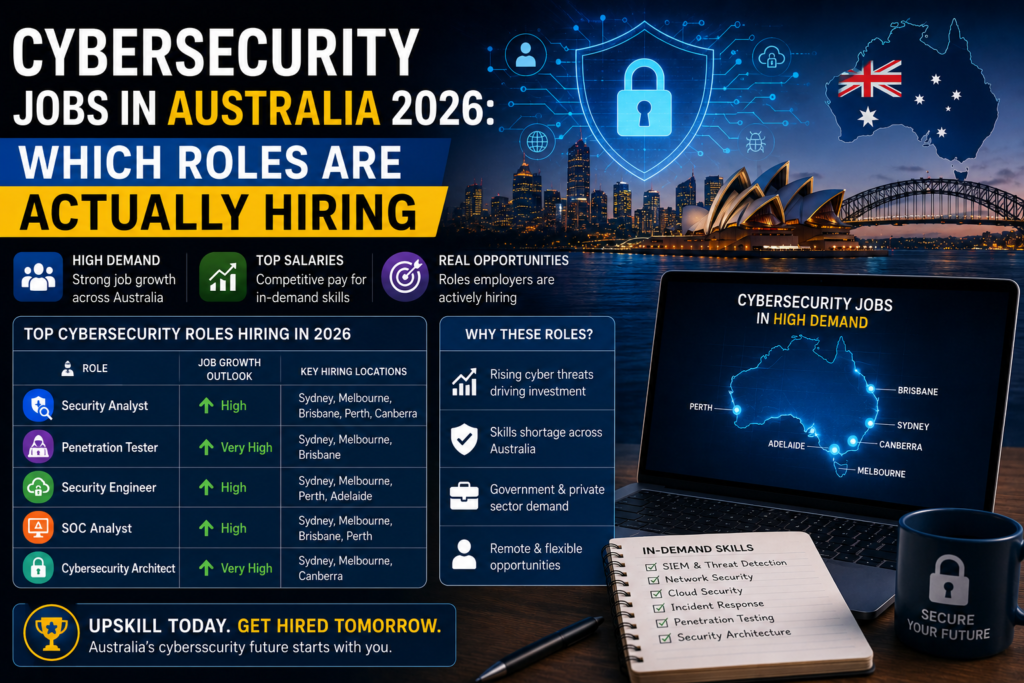
Cybersecurity Jobs in Australia 2026 is a very different search today than it was even two years ago. Job boards are still full of “cybersecurity analyst” listings, but the roles actually getting filled and the ones sitting open for months are much more specific. If you’re studying for a certification and picking a lane, knowing which roles are genuinely hiring right now matters more than the job title on the course brochure.
We looked at what’s actually moving in the Australian market across the three roles jobseekers ask about most: SOC Analyst, Penetration Tester and Cloud Security Engineer plus what employers in Sydney, Melbourne, Brisbane, Perth, Adelaide and Canberra are paying for each.
Why the Market Has Shifted
Cybersecurity hiring in Australia has moved from generalist “security analyst” roles toward specialised positions, largely driven by cloud migration, ransomware pressure on critical infrastructure, and the government’s ongoing cyber uplift initiatives. Employers now hire for a specific gap in the team rather than a broad security generalistwhich is good news if you’ve picked a specialisation, and a trap if you’re still positioning yourself as a generalist.
SOC Analyst Roles in Cybersecurity Jobs in Australia 2026
- Highest volume of entry-to-mid-level openings of the three roles, especially in Managed Security Service Providers (MSSPs).
- Strong demand in Melbourne and Sydney due to concentration of MSSPs and bank/insurance security operations centres.
- Typical progression: SOC Analyst L1 → L2 → Threat Hunter or Incident Response specialist within 2–3 years.
- Entry point of choice for career changers, since many roles accept CompTIA Security+ or equivalent plus SIEM familiarity.
Penetration Tester Roles in Cybersecurity Jobs in Australia 2026
- Fewer roles overall, but consistently hard to fill — genuine offensive security skills remain scarce nationally.
- Concentrated in consultancies and larger enterprises across Sydney, Melbourne and Canberra (government-adjacent testing work).
- Requires demonstrable hands-on skill (OSCP, CEH or similar) — this is one area where practical labs outweigh multiple-choice certifications at interview stage.
- Highest pay ceiling of the three roles for experienced testers, but a harder entry point for beginners.
Cloud Security Roles in Cybersecurity Jobs in Australia 2026
- Fastest-growing category of the three, tracking directly with AWS, Azure and GCP adoption across Australian enterprises.
- Strong demand in Perth and Brisbane as mining and resources companies shift infrastructure to cloud.
- Certifications like Azure Security Engineer Associate or AWS Security Specialty are increasingly requested by name in job ads.
- Best overlap role for candidates coming from a cloud/DevOps background wanting to move into security.
Cybersecurity Jobs in Australia 2026: Role Comparison
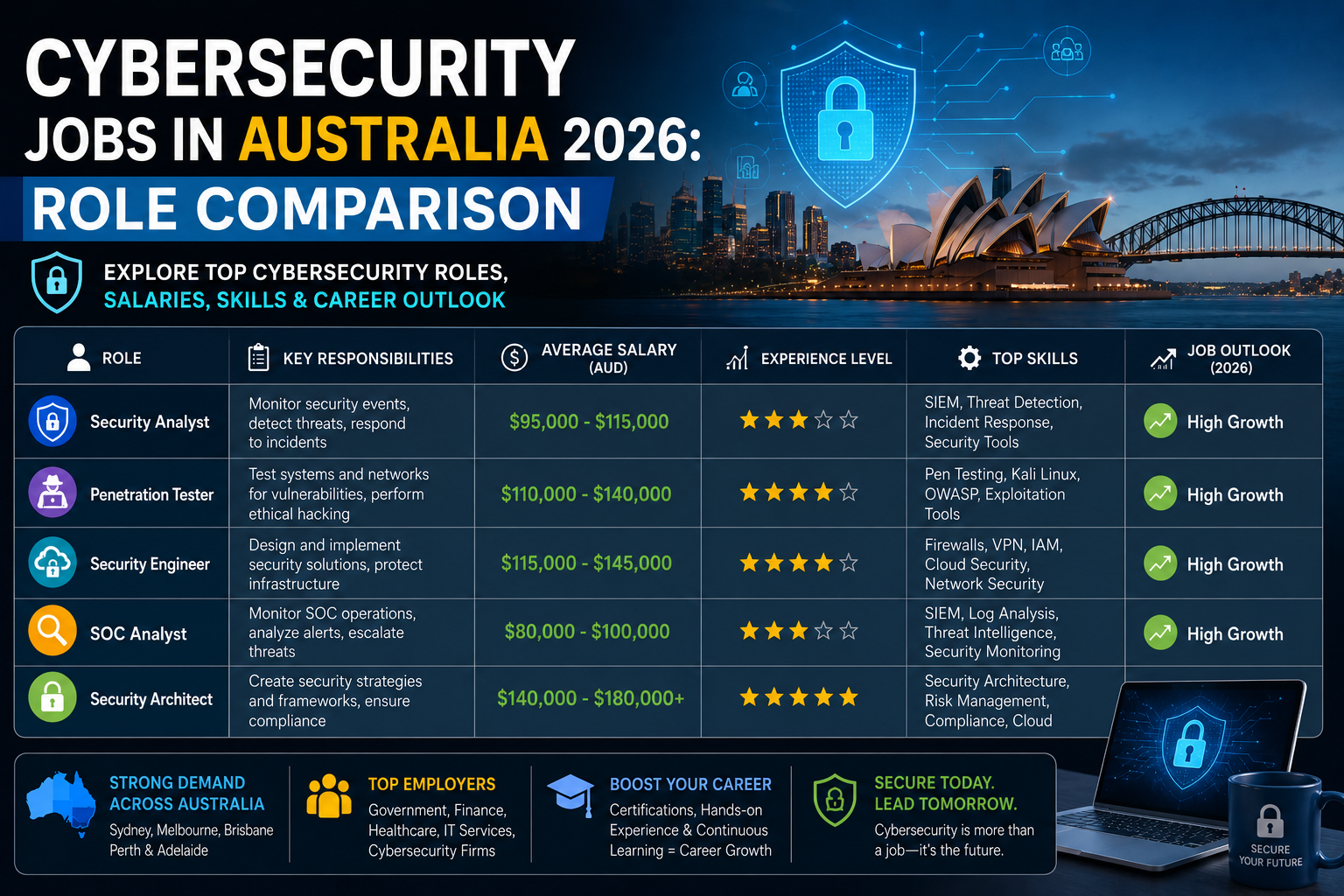
| Factor | SOC Analyst | Penetration Tester | Cloud Security Engineer |
| Hiring volume | Highest | Lowest, but persistent | Fastest growing |
| Entry difficulty | Easiest entry point | Hardest — needs hands-on proof | Moderate, easier with cloud background |
| Typical AU salary | $70k–$100k | $100k–$160k+ | $110k–$150k |
| Key certifications | Security+, SC-200 | OSCP, CEH | AZ-500, AWS Security Specialty |
| Best AU cities for roles | Sydney, Melbourne | Sydney, Melbourne, Canberra | Perth, Brisbane, Sydney |
What the Official Data Confirms
This picture lines up with national guidance too. The Australian Cyber Security Centre’s advisories and guidance reflect the sustained focus on ransomware and critical infrastructure protection driving demand for both SOC and cloud security roles across the country. AustCyber’s sector reporting has repeatedly flagged the ongoing cybersecurity workforce shortage as one of the most persistent skills gaps in the Australian tech sector, which is why penetration testing and cloud security roles remain hard to fill even amid broader tech hiring slowdowns.
On the numbers side, Seek’s cybersecurity hiring and salary insights consistently show SOC and analyst-level roles as the highest-volume postings, while the Australian Bureau of Statistics continues to list professional, scientific and technical services — the category most cybersecurity roles fall under — among the fastest-growing employment sectors nationally. Global context from (ISC)²’s cybersecurity workforce research also backs this up, consistently identifying cloud security and hands-on offensive security skills as among the most in-demand globally, not just locally.
Which Cybersecurity Job Should You Target in 2026?
- New to cybersecurity? SOC Analyst is the most accessible entry point with the highest volume of Australian job ads.
- Want the highest pay ceiling and don’t mind a harder entry? Penetration Testing rewards hands-on skill over qualifications alone.
- Coming from IT infrastructure or DevOps? Cloud Security is the fastest-growing and most natural transition.
- Based in Perth or Brisbane? Cloud Security roles are growing fastest in these markets due to mining-sector cloud migration.
Building the Right Certification Pathway
Most Australian cybersecurity professionals start with a foundational certification, move into a SOC Analyst role to build practical experience, then specialise into penetration testing or cloud security once they know which direction suits them.
Frequently Asked Questions About Cybersecurity Jobs in Australia 2026
Which cybersecurity role is easiest to break into in Australia?
SOC Analyst roles have the highest volume of entry-level openings and typically accept candidates with a foundational certification like Security+, making it the most accessible starting point.
Do I need a degree for cybersecurity jobs in Australia?
Not always. Many Australian employers accept industry certifications and demonstrable hands-on skill in place of a formal degree, particularly for SOC Analyst and Cloud Security roles.
Is penetration testing a good career path in Australia?
Yes, it offers the highest salary ceiling of the three roles covered here, though it’s the hardest to break into without hands-on lab experience and a recognised offensive-security certification like OSCP.
Which cities have the most cybersecurity job openings?
Sydney and Melbourne lead for SOC Analyst and Penetration Testing roles, while Perth and Brisbane are seeing the fastest growth in Cloud Security roles due to mining-sector cloud adoption.
What certification should I get first for a cybersecurity career in Australia?
A foundational certification such as CompTIA Security+ is the most common starting point, after which most professionals specialise toward SOC operations, penetration testing or cloud security based on interest and background.
Bottom line: Cybersecurity Jobs in Australia 2026 are increasingly specialised — SOC Analyst offers the easiest entry, Penetration Testing the highest pay ceiling, and Cloud Security the fastest growth. Picking a lane early and certifying toward it beats staying a generalist in today’s market.