


Security+ vs CySA+ is one of the most searched cybersecurity certification comparisons in Australia right now, and for good reason both sit on the CompTIA cybersecurity pathway, but they’re built for completely different career stages. Pick the wrong one and you either waste months studying content you’re not ready for, or you get a certification that doesn’t move your career forward. This guide breaks down exactly how Security+ and CySA+ differ, what each one costs, what roles they lead to, and which one you should start with based on where you are right now.
Security+ vs CySA+ at a Glance
| CompTIA Security+ | CompTIA CySA+ | |
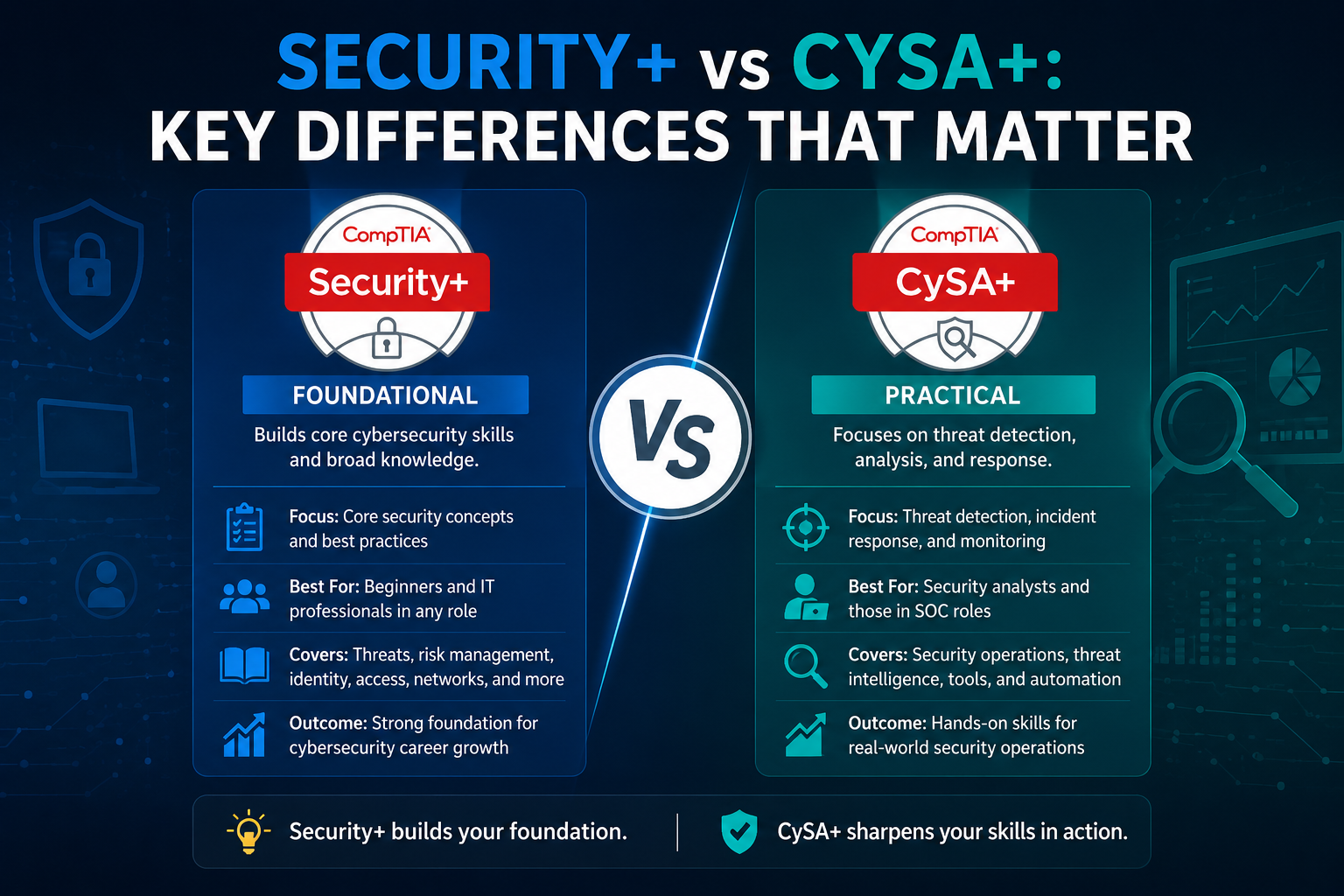
| Level | Entry-level, foundational | Intermediate/advanced, analyst-focused |
| Best for | Career changers, IT support staff, first cyber role | SOC analysts, existing security/IT professionals |
| Focus | Core security concepts, risk, cryptography, network security | Threat detection, behavioural analytics, incident response |
| Prerequisites | None required (Network+ or ~2 yrs IT experience recommended) | Security+ knowledge or equivalent SOC experience recommended |
| Typical roles after | Security Analyst I, SOC Analyst I, IT Security Specialist | SOC Analyst II/III, Threat Intelligence Analyst, Incident Responder |
| DoD 8140 approved | Yes | Yes |
What Is CompTIA Security+?
CompTIA Security+ is the industry-standard entry point into cybersecurity. It covers the fundamentals every security professional needs: network security, threat types, cryptography, identity management, risk management, and governance. Because it assumes no prior security-specific experience, Security+ is the certification most Australian employers expect to see on a first cybersecurity resume, and it’s also the credential most career changers start with when moving out of general IT support.
What Is CompTIA CySA+?
CompTIA CySA+ sits a level above Security+. Instead of covering security fundamentals broadly, CySA+ is built around behavioural analytics — using data and threat intelligence to detect, analyse, and respond to security incidents before and after they happen. CySA+ is designed for people already working in or moving into security operations centre (SOC) roles, and it’s a common next step after 1–2 years of hands-on experience following Security+.
Security+ vs CySA+: Key Differences That Matter
Difficulty and Depth
Security+ tests broad foundational knowledge across every core domain of cybersecurity. CySA+ goes deeper into fewer areas specifically threat detection, log analysis, vulnerability management, and incident response — and expects you to apply that knowledge to realistic scenarios, not just recall definitions. Most learners find CySA+ noticeably harder, which is exactly why it’s positioned as the next step rather than a starting point.
Career Stage
Security+ answers the question “how do I get my first cybersecurity job?” CySA+ answers “how do I move from a general security role into a specialised analyst role?” If you’re currently in help desk, network administration, or general IT support, Security+ is almost always the right starting point. If you’re already working as a SOC Analyst I or security support technician and want to progress, CySA+ is the natural next certification.
Salary Impact
Security+ holders typically move into entry-level analyst and security specialist roles, while CySA+ is associated with mid-level SOC analyst and incident response positions that carry a meaningful salary step up. For a detailed breakdown by role and city, see our CompTIA CySA+ Career and Salary Guide Australia.
Exam Format
Both exams are performance-based and multiple choice combined, but CySA+ places heavier weight on performance-based questions that simulate real analyst tasks interpreting logs, prioritising alerts, and recommending remediation steps.
Should You Start With Security+ or CySA+?
Use this quick self-check:
- Choose Security+ if: you’re new to cybersecurity, coming from general IT, or have no formal security experience yet.
- Choose CySA+ if: you already hold Security+ (or equivalent experience), and you’re working toward or already in a SOC analyst, threat intelligence, or incident response role.
- Choose both, in sequence, if: you’re planning a structured 12–18 month pathway from IT support into a specialised cybersecurity analyst career this is the most common and most employer-recognised route in Australia.
If you want the full sequencing beyond these two certifications, our Cyber Security Certification Roadmap Australia: From Security+ to Advanced Roles maps out what comes next, including PenTest+ and PCNSA.
Security+ vs CySA+: Which Costs More?
Exam and training costs vary by provider and delivery format. For a full local breakdown across both certifications, see our Cyber Security Certification Cost in Australia 2026 guide before you budget your study plan. Official exam objectives and vouchers are published directly by CompTIA, which is worth checking before you enrol in any training.
Live Cybersecurity Certification Training Across Australia
Both certifications are available as live, instructor-led training through Cybersecurity Certifications, with hands-on labs and flexible weekday, evening, and weekend delivery. Training is available for learners based in:
Browse the full course list or contact a training advisor to confirm which certification matches your current experience level.
FAQ: Security+ vs CySA+
Can I skip Security+ and go straight to CySA+?
CompTIA doesn’t enforce a formal prerequisite, but CySA+ assumes Security+-level knowledge. Skipping straight to CySA+ without that foundation is possible but significantly harder, and most training providers recommend Security+ first unless you already have equivalent hands-on SOC experience.
How long does it take to prepare for each certification?
Security+ typically takes 6–10 weeks of part-time study for someone with basic IT knowledge. CySA+ usually takes a similar timeframe once you already hold Security+, since you’re building on existing foundations rather than starting from zero.
Is CySA+ worth it if I already have Security+?
Yes, for most SOC-track careers. CySA+ signals that you can do the analyst work itself detecting and responding to threats rather than just understanding security concepts, which is what employers are specifically hiring for in SOC Analyst II and III roles.
Which certification do Australian employers ask for most?
Security+ appears in more entry-level cybersecurity job postings simply because it’s the standard baseline. CySA+ appears more frequently in SOC analyst and incident response postings, where employers are hiring for depth rather than breadth.
Do both certifications expire?
Yes. Both Security+ and CySA+ are valid for three years and require continuing education units (CEUs) or renewal to stay current, which also keeps your skills aligned with the current threat landscape.
Ready to Choose Your Certification Path?
Whether you’re starting with Security+ or ready to step up to CySA+, live instructor-led training gets you there faster than self-study alone. Talk to a training advisor or call 1300 649 299 to confirm the right starting point for your experience level and city.