


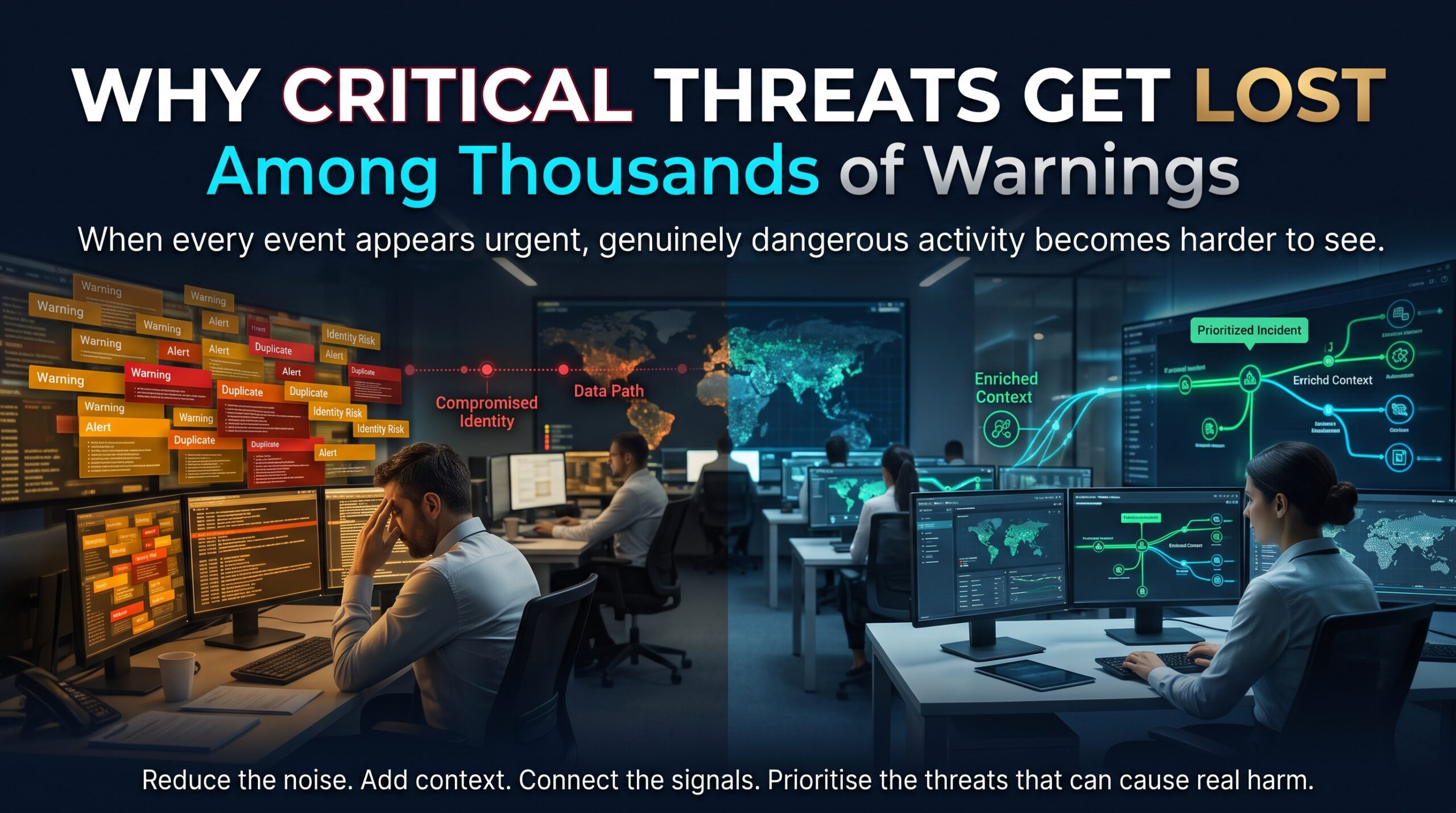
Security alert overload is the quiet reason many organisations miss the one warning that mattered. Every day, firewalls, endpoint tools, cloud platforms and email filters fire off thousands of notifications. Most are harmless. A few are real. Somewhere in that flood sits the alert that signals an attacker already inside the network, and it looks exactly like everything around it. When people are tired, busy and outnumbered, that alert gets closed with the rest.
This guide explains why security alert overload happens, what the research says about it, how to spot it in your own team, and how to fix it. It also shows which certifications build the skills analysts need to cut through the noise, including CompTIA CySA+ training and other cyber security certification courses available across Australia.
Quick answer: critical threats get lost because teams face too many alerts, too many false positives, too many disconnected tools and too few people. The fix is to reduce noise at the source, add context to every alert, automate repetitive triage and train analysts to investigate faster and smarter.
What Is Security Alert Overload?
Security alert overload happens when the number of alerts a team receives is larger than the number it can realistically investigate. It is closely linked to alert fatigue, the desensitisation analysts develop when they face a constant stream of warnings. Vectra AI explains that the term comes from healthcare, where staff learned to tune out constant monitor alarms, and the same thing now happens in security operations centres (SOCs).
Picture a smoke alarm that goes off every time someone makes toast. After a month, you stop looking up. When a real fire starts, the alarm sounds exactly the same, and you ignore it. That is the heart of the problem: when everything is flagged as urgent, nothing feels urgent.
Why Critical Threats Get Lost Among Thousands of Warnings
Security alert overload rarely has a single cause. These factors usually stack on top of each other.
1. False positives drown out real alerts
Many alerts turn out to be harmless: a staff member travelling, a software update, a scan that looks suspicious but is not. Every false alarm costs an analyst time and chips away at trust in the alerts themselves.
2. Tool sprawl creates too many dashboards
Endpoint protection, SIEM, identity, cloud and email tools each produce their own alerts with their own severity scores. Analysts jump between consoles trying to connect the dots by hand, and a single attack can look like five unrelated low-priority events.
3. Detection rules are never tuned
Default thresholds and duplicate rules generate noise from the start. Without regular tuning, the same harmless event triggers hundreds of tickets.
4. Manual triage cannot keep up
When every alert needs a person to gather context, check logs and decide what to do, volume will always outrun capacity. Repetitive tasks eat the time that should go to real investigations.
5. Too few people and too many skills gaps
Security teams are stretched, and junior analysts often burn out and leave. Each departure takes experience away just when it is needed most.
6. Success is measured by tickets closed
When teams are rewarded for closing alerts quickly, clearing the queue becomes the goal instead of stopping attackers. Speed beats accuracy, and subtle threats slip through.
7. Attackers hide in the noise
Skilled attackers deliberately keep their activity looking low-key, using trusted cloud services and quiet persistence so alerts appear low-priority. Intezer’s 2026 analysis, described in its blog on missed threats, found that roughly 1% of confirmed incidents began as alerts labelled low-severity or informational. The figure is from a vendor, so treat it as an indicator, but it shows why ignoring “minor” alerts is risky.
Security Alert Overload by the Numbers
Several industry reports try to measure the problem. As summarised by Vectra AI, which collects figures from other publishers, the picture looks like this:
- Organisations receive an average of about 2,992 security alerts per day, and about 63% go unaddressed (Vectra AI, 2026).
- Around 42% of alerts are never investigated and roughly 46% are false positives, with organisations running an average of 10.9 security consoles (Microsoft and Omdia, 2026).
- About 76% of organisations name alert fatigue as a primary SOC concern (Cybersecurity Insiders, 2025).
- About 73% of security teams say false positives are their top detection challenge (SANS, 2025).
These numbers come from different surveys and some are published by security vendors, so they are best read as signals rather than precise measurements. Check the original reports before quoting them in a board paper. The direction, however, is consistent: alert volumes are rising and teams cannot keep pace.
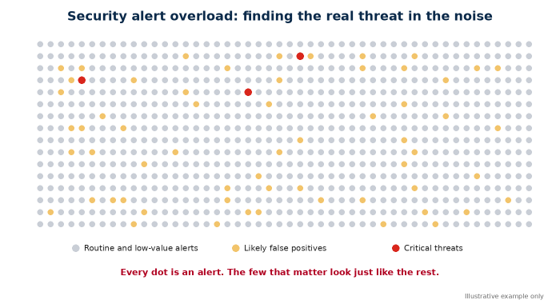
Figure 1: Security alert overload hides the few critical alerts among thousands of routine ones (illustrative).
Signs Your Team Is Suffering from Security Alert Overload
- Alert queues grow faster than they shrink, and backlogs become normal.
- Analysts bulk-close alerts or ignore low-severity categories entirely.
- Nobody can explain why a particular alert fired or what “normal” looks like.
- Incidents are discovered by customers, auditors or attackers rather than by your tools.
- Experienced staff are leaving and new staff take months to become effective.
- The team uses many tools but trusts none of them.
- Investigations take a long time because context must be gathered by hand.
The Real Cost of Security Alert Overload
The most obvious cost is a missed attack. The longer an intruder stays undetected, the more data they can reach and the harder recovery becomes. Slow detection can also push breach reporting past deadlines set by regulators. In Australia, organisations should keep up with guidance from the Australian Cyber Security Centre and check their own reporting obligations.
There are quieter costs too. Analysts who spend their days chasing false alarms burn out and leave. Fragmented security operations cost more to run. And the business loses confidence in a security team that cannot show what is really going on.
How to Fix Security Alert Overload: A 30-60-90 Day Plan
You do not have to fix everything at once. A staged plan keeps the work realistic and shows early wins.
| Timeframe | Focus | Example actions |
| Days 0 to 30 | Quick wins | Disable redundant rules, tune thresholds, merge duplicate alerts, add basic risk scoring |
| Days 30 to 60 | Add context | Enrich alerts with user, asset and network data, prioritise by risk, start an analyst-to-detection feedback loop |
| Days 60 to 90 | Automate and measure | Automate repetitive responses, consolidate tools, track KPIs such as time to contain |
Within that plan, these seven habits make the biggest difference:
- Treat noise as a risk. Stop assuming more alerts means better protection.
- Tune detection rules regularly. Remove what never produces a useful result.
- Correlate signals across tools. Combine identity, endpoint, cloud and network data into one story.
- Score alerts by risk, not just severity. Consider how valuable the asset is and how the user normally behaves.
- Automate the repetitive work. Account disables, password resets and notifications do not need a human.
- Measure outcomes. Track dwell time and time to contain instead of tickets closed.
- Invest in skills. Better-trained analysts triage faster and escalate with more confidence.
The CSO Online guidance on breaking free from alert fatigue makes a similar point: treat alert volume as a risk, track outcomes that matter to the business, and build resilient playbooks.
Skills That Cut Through Security Alert Overload
Technology helps, but people still make the final call. Analysts who understand how attacks work and how to read logs can separate signal from noise much faster. These courses from cybersecuritycertifications.au build exactly those skills:
- CompTIA Security+: core security concepts, threats and controls for beginners and IT professionals.
- CompTIA CySA+: behavioural analytics, threat detection and incident response for SOC analysts.
- CompTIA PenTest+: think like an attacker to understand what real malicious activity looks like.
- Palo Alto PCNSA: configure and manage Palo Alto firewalls and understand their alerts.
- Microsoft AZ-500: secure Azure environments and work with cloud security alerts.
Not sure where to start? Browse the full course list, read the FAQs, learn about the training provider or see more articles on the cyber security blog.
Cyber Security Training Across Australia
If security alert overload is hurting your team, practical training is one of the fastest ways to help. Instructor-led courses are available in your city:
- Cyber security training Melbourne: in-person and live online.
- Cyber security training Sydney: in-person and live online.
- Cyber security training Brisbane: in-person and live online.
- Cyber security training Perth: live online and in-house.
- Cyber security training Adelaide: live online and in-house.
- Cyber security training Canberra: live online and in-house.
Teams in Hobart can join live online, and in-house training can be arranged for your organisation. See every option on the locations page or contact the team on 1300 649 299.
Frequently Asked Questions About Security Alert Overload
What is security alert overload?
It is when a security team receives more alerts than it can investigate, so real threats are delayed, missed or ignored among false alarms.
What is the difference between alert overload and alert fatigue?
Alert overload is the flood of alerts. Alert fatigue is the exhaustion and desensitisation analysts feel as a result.
Why do SOCs ignore low-severity alerts?
Because they cannot investigate everything. Teams prioritise by severity labels, but attackers can make real activity look minor, so low-severity alerts are not always safe to skip.
How can I reduce false positives?
Tune detection rules to your environment, merge duplicates, add context such as asset value and user behaviour, and create a feedback loop so analysts can report noisy rules.
Which certification helps most with alert triage?
CompTIA CySA+ focuses on threat detection and analysis, and CompTIA Security+ gives a solid foundation. Microsoft AZ-500 suits teams working with cloud security alerts.
Final Thoughts
Security alert overload is not a failure of effort. It is the result of tools that generate more warnings than people can read. Reduce the noise at the source, add context, automate the routine and measure what matters. Then invest in the people who make the decisions. When you are ready to build job-ready skills, explore our cyber security certification courses and take the next step.