


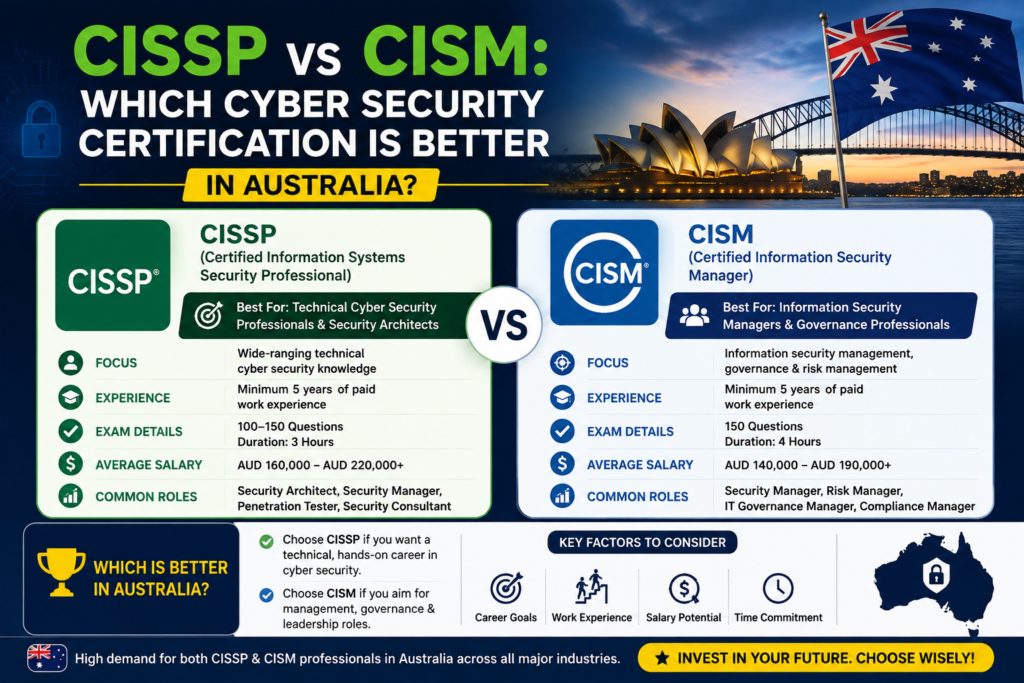
CISSP vs CISM is one of the most searched cybersecurity certification comparisons in Australia right now, and for good reason – both are elite, six-figure credentials, but they point toward genuinely different careers. Get the choice right and you save months of study time and land in the role you actually want; get it wrong and you end up with a credential that doesn’t match the job you’re applying for.
Looking to improve your business analyst skills and prepare for your next interview? We support learners and professionals in Sydney, Melbourne, Brisbane, Perth, Adelaide, Canberra, Gold Coast, Hobart, Darwin, and across Australia. Call our training team on tel:1800 159 151 to find the right business analyst course for your career goals.
CISSP vs CISM: The Core Difference
The CISSP (Certified Information Systems Security Professional), issued by ISC2, is broad and technical it spans eight domains covering everything from cryptography and network architecture to software development security and physical controls. It proves you can design and evaluate secure systems across an entire technology environment.
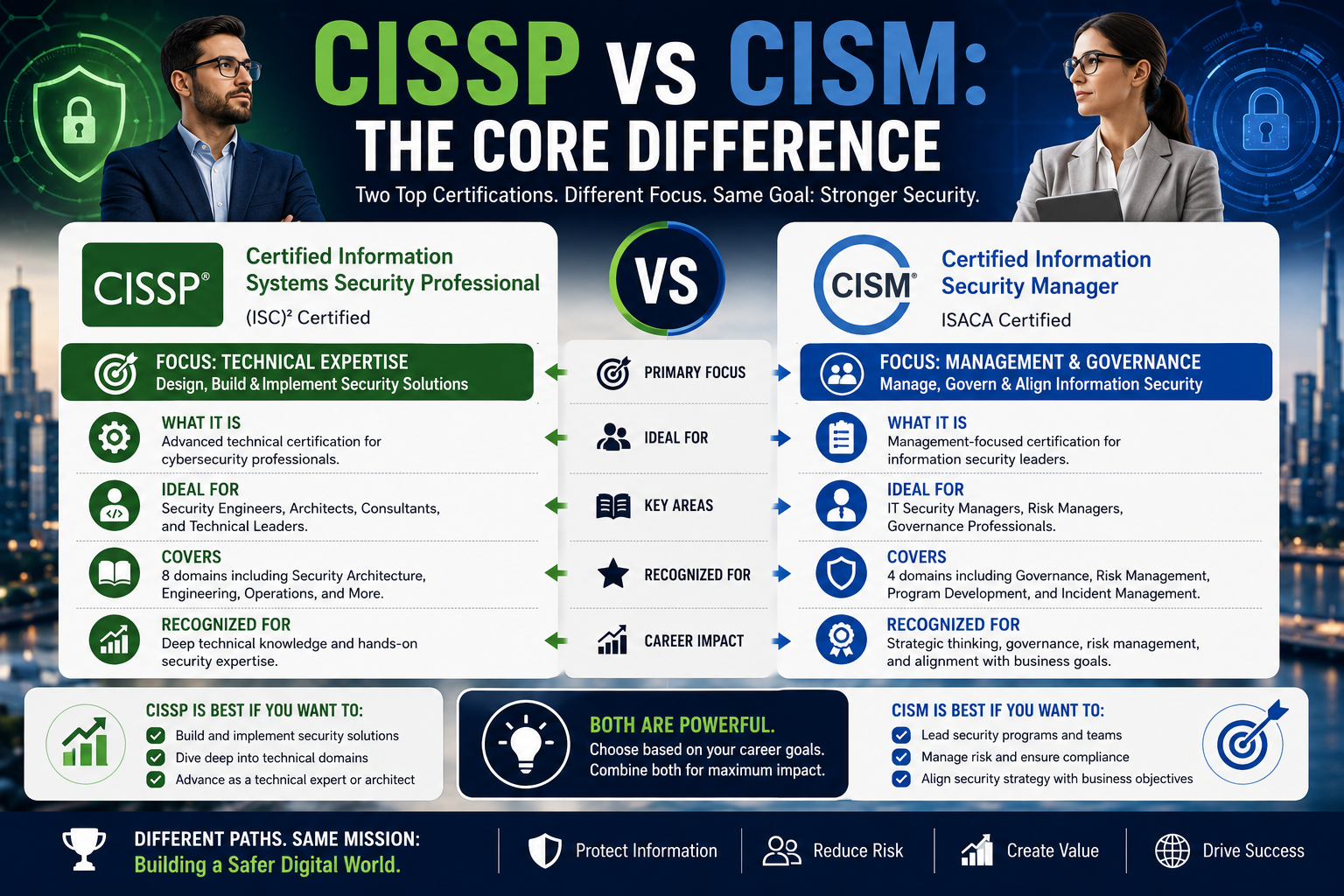
The CISM (Certified Information Security Manager), issued by ISACA, is narrower and deeper on governance, risk, and security program leadership. It proves you can run a security program, align it with business goals, and lead incident response – not configure the individual controls that make it work.
Put simply: CISSP answers “how do we design and implement secure systems?” CISM answers “how do we govern and manage a security program?”
CISSP vs CISM: Full Comparison Table (2026)
| Factor | CISSP (ISC2) | CISM (ISACA) |
| Focus | Broad technical + managerial security (8 domains) | Security management, governance & risk (4 domains) |
| Best for | Security architects, engineers, consultants, CISOs (technical route) | Security managers, GRC leads, aspiring CISOs (management route) |
| Experience required | 5 years across 2+ of 8 domains (4 years with a degree/waiver) | 5 years in information security, 3 in security management |
| Exam format | 125-175 adaptive questions, up to 4 hours | 150 questions, 4 hours |
| Exam cost (AUD, approx.) | ~$1,050-$1,100 | ~$1,100-$1,150 (non-member); lower for ISACA members |
| Annual maintenance fee | ~$135 USD + 40 CPE credits/year | ~$45-$85 USD + CPE credits, renewed every 3 years |
| Typical Australia salary | $150,000-$180,000 (up to $200,000+ in Sydney/Melbourne) | $120,000-$150,000, higher in dedicated management roles |
Figures are indicative, drawn from public 2026 market and vendor data, and will vary by employer, industry, and negotiation. Always confirm current exam pricing on the official ISC2 and ISACA websites.
CISSP vs CISM: Exam Cost in Australia
The CISSP exam fee is set by ISC2 at USD $749, which converts to roughly AUD $1,050-$1,100 depending on exchange rates at the time of booking, plus an ongoing annual maintenance fee of USD $135. Full pricing is available on the official ISC2 exam pricing page.
The CISM exam fee is set by ISACA at USD $575 for members or USD $760 for non-members, which lands around AUD $1,100-$1,150 for non-members once converted, plus a one-time USD $50 application fee and lower ongoing annual maintenance (USD $45-$85) than CISSP. ISACA membership (roughly USD $145/year) often pays for itself through the exam discount alone.
CISSP vs CISM: Salary in Australia
CISSP holders in Australia typically earn between $150,000 and $180,000, with senior security roles in Sydney and Melbourne regularly exceeding $200,000. The credential carries particular weight in government, finance, and defence contracting, where broad technical credibility across all eight security domains is valued.
CISM holders in Australia typically earn between $120,000 and $150,000, with a strong concentration in dedicated Information Security Manager, GRC lead, and CISO-track roles, where salaries can match or exceed CISSP once the role itself is management-focused. The salary gap between the two credentials is driven less by the certification itself and more by the role mix – CISM holders cluster in management positions, which pay more regardless of the certification behind them.
Many senior Australian security leaders end up holding both. A CISSP-plus-CISM combination signals technical depth and management credibility simultaneously, and is common among candidates targeting CISO or Director of Security roles.
CISSP vs CISM: Prerequisites and Exam Difficulty
- CISSP prerequisites: five years of paid work experience across at least two of the eight CBK domains (four years with an approved degree or credential waiver). Candidates without the experience can sit the exam and become an “Associate of ISC2” while accumulating the required hours over six years.
- CISM prerequisites: five years of information security experience, with at least three years specifically in security management across the exam’s domains, completed within the ten years before applying.
On difficulty, CISSP is generally considered the harder exam because of its broader scope (eight domains vs. four) and computer-adaptive testing format, which adjusts question difficulty based on your performance in real time. CISM’s difficulty comes from a different direction it demands management-level thinking, such as justifying a risk decision to a board, rather than technical recall.
CISSP vs CISM: Which Career Path Fits You?
Choose CISSP if:
- You’re in a technical security role and want to stay hands-on across architecture, engineering, or consulting.
- You want the most versatile, widely recognised security credential globally.
- You’re targeting government, defence, or DoD-aligned contracting roles that specifically require CISSP.
- You’re planning to reach CISO via the technical route (Security Engineer → Architect → Security Director).
Choose CISM if:
- You’re already managing people or programs, or want to move from a technical role into leadership.
- You’re targeting Information Security Manager, GRC Lead, or Director-level roles where governance and risk matter more than configuration.
- You prefer a more focused, management-specific study experience over CISSP’s eight-domain breadth.
- You’re eyeing a CISO role via the governance and risk route rather than the technical route.
Do You Need Both CISSP and CISM?
Not to start – pick the one that matches your current role and the job you want next. But if you’re already several years into a security career and aiming at Director of Security or CISO, holding both certifications within 6-12 months of each other is common among senior Australian candidates, since the overlap in governance, risk, and incident management content makes studying for the second considerably faster than the first.
Where to Study CISSP and CISM Preparation in Australia
Structured cyber security training is available online nationwide and in person across major Australian cities. cybersecuritycertifications.au runs certification-aligned cyber security courses in Sydney, Melbourne, Brisbane, Perth, Adelaide, and Canberra, including foundational and associate-level courses such as CompTIA Security+, CompTIA CySA+, and Microsoft AZ-500, which build the practical foundation most candidates need before attempting CISSP or CISM. Browse the full course catalogue or get in touch to plan the right pathway for your experience level.
Final Thoughts
CISSP vs CISM isn’t really a question of which is objectively better – it’s a question of which matches the career you’re building. If you want to stay technical, or you need the broadest, most globally recognised security credential for architecture, engineering, or government-aligned work, CISSP is the stronger choice. If you’re moving into or already working in security management, governance, or risk, and you’re targeting a CISO or Director-track role, CISM will match your day-to-day work more closely and often carries more weight in those specific interviews. Whichever you choose, building the underlying technical foundation first – through certifications like Security+, CySA+, or AZ-500 – makes both exams significantly more manageable.
Ready to build the foundation first? Explore cyber security courses in Australia or enquire now to find the right training path for you.