


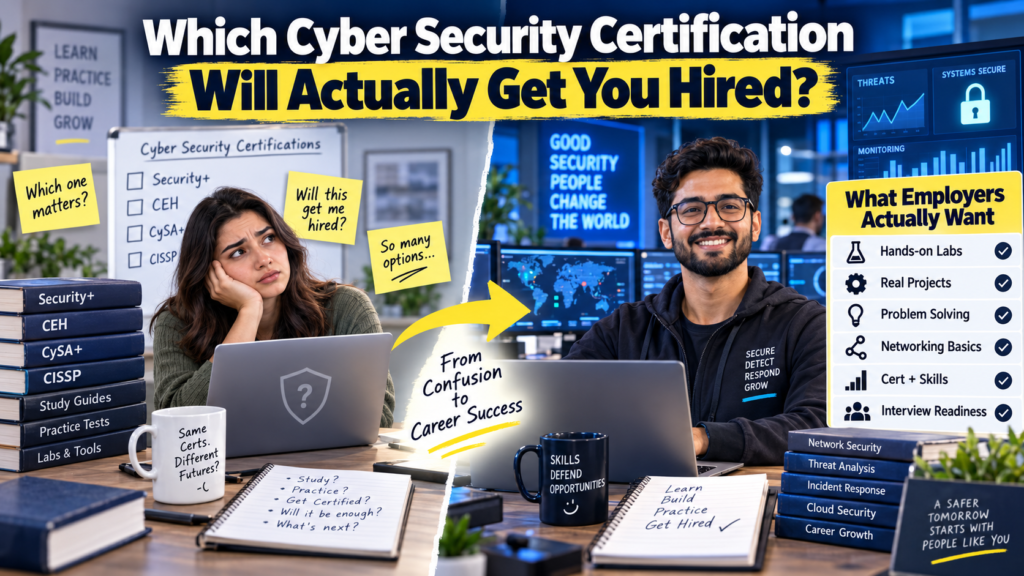
The cyber security certification to get hired is the one that matches the job you’re actually applying for, and that’s the part most guides skip. They hand you a list of ten acronyms and leave you to guess. So people spend money and months on a certificate, add it to LinkedIn, and wait for the phone to ring.
It rarely rings straight away, and that’s not because certifications don’t matter. They do. It’s because hiring managers aren’t deciding on the certificate alone. They’re asking whether you can do the job, whether they can trust you with systems and data, and whether they can defend the hire to their own boss.
This guide answers the question properly: which cyber security certification to get hired for each role, what has to sit next to it, how Australian security clearances change the picture, and what to expect in your city.
The Cyber Security Certification to Get Hired Depends on Your Target Role
If you want one safe starting point, CompTIA Security+ is the most common first step for a reason. If you already know the role you want, use this shortlist to find the right cyber security certification to get hired:
- Security analyst or SOC analyst: Security+, then CySA+.
- Microsoft and Azure-heavy employers: AZ-500, ideally with some Azure experience behind it.
- Penetration tester: PenTest+ plus hands-on practice you can show.
- Network security or firewall engineer: PCNSA for Palo Alto environments.
- Governance, risk and leadership: CISSP or CISM later, once you have the experience.
Notice the pattern. The answer changes with the role, which is why a single “best certification” list never quite works. The rest of this guide explains the reasoning.
Why a Certification Alone Rarely Gets You Hired
Think of a hiring decision as a stack. The certification is one layer. It helps your resume get past the first filter, but it sits on top of four other things:
- Baseline IT experience: help desk, systems or network administration all count. Security teams like people who understand how systems normally behave.
- Hands-on evidence: lab write-ups, a home lab, SIEM queries or a vulnerability assessment of a practice environment.
- Clear communication: writing incident reports and explaining risk to non-technical people is daily work.
- Eligibility: many government and defence roles require citizenship and a security clearance.
A certification tells an employer you’ve met a standard. Evidence tells them you can apply it. Candidates who show both usually beat candidates who show one, and that’s where many certified people lose out. Remember there are two audiences too: recruiters and software screen for keywords first, then a technical manager screens for competence. The right cyber security certification to get hired helps with the first. Your projects win the second.
What Job Ads Actually Ask For (and How to Check for Yourself)
Don’t take anyone’s word for which certification wins, including ours. You can test the market in under an hour. Pull 20 current ads for the role you want on SEEK and LinkedIn, then tally which certifications and tools appear. Patterns show up quickly, and they tell you which cyber security certification to get hired for that specific role.
Two things tend to stand out. Ads often list a certification as desirable or “or equivalent” rather than mandatory, which means hands-on evidence can carry real weight. And the same tools appear next to the certificates: SIEM platforms, endpoint tools, cloud platforms and scripting. If you’re targeting SOC roles, our comparison of Microsoft Sentinel vs Splunk is worth a read. Write down the exact phrases the ads use. They belong on your resume, as long as they’re true.
Two Candidates, One Job: Who Gets the Interview?
Picture two applicants for the same junior SOC analyst role. The first holds three certifications and nothing else: no projects, no IT work history, and a resume that lists acronyms. The second holds only Security+, but has a year of help desk experience, a home lab where they’ve investigated sample alerts, and a short write-up explaining what they found.
Most hiring managers will interview the second candidate. That’s not because certifications don’t count. It’s because the second person has shown how they think. It’s the real test for any cyber security certification to get hired: does it come with proof that you can use it? The lesson isn’t to skip certifications. It’s to stop treating them as the whole application.
Best Cyber Security Certification to Get Hired by Role
Security Analyst or SOC Analyst: Security+ Then CySA+
Most entry-level analyst ads assume you understand core security concepts, and CompTIA Security+ is the vendor-neutral way to prove it. CompTIA recommends some IT experience before you sit it, so if you’re coming from help desk or admin work you’re well placed. Once you’re working alerts, CompTIA CySA+ builds the next layer employers look for: threat detection, analysis and response. Torn between the two? Read Security+ vs CySA+.
Cloud and Microsoft Security: AZ-500
If your target employers run on Microsoft 365 and Azure, AZ-500 speaks their language. It works best when you already have some Azure or admin experience, because the exam assumes you know what you’re securing. Our SC-200 vs AZ-500 comparison helps you choose between the analyst-focused and engineer-focused Microsoft options.
Penetration Tester: PenTest+ Plus Proof
CompTIA PenTest+ covers planning, scanning, exploitation and reporting, and it’s a solid way into offensive security. Pentest hiring leans harder on practical proof than most areas, though. Publish sanitised write-ups from legal practice labs and challenges, and be ready to explain your method. Only ever test systems you own or have written permission to test. Some senior roles also ask for hands-on exams beyond entry level.
Network Security and Firewalls: PCNSA
If you’re aiming at network security engineering, especially where Palo Alto firewalls are in use, PCNSA shows you can configure and manage them. It’s narrower than Security+, so it works best when you already have networking experience or a job ad that names Palo Alto.
Governance, Risk and Leadership: CISSP and CISM Later
CISSP and CISM carry weight in governance and management roles, but both expect several years of relevant experience, which makes them a poor first step. Treat them as a later goal and read our CISSP vs CISM comparison for Australia when you get there.
Cyber Security Certification to Get Hired at a Glance
Use this table to match the cyber security certification to get hired with your background and target job:
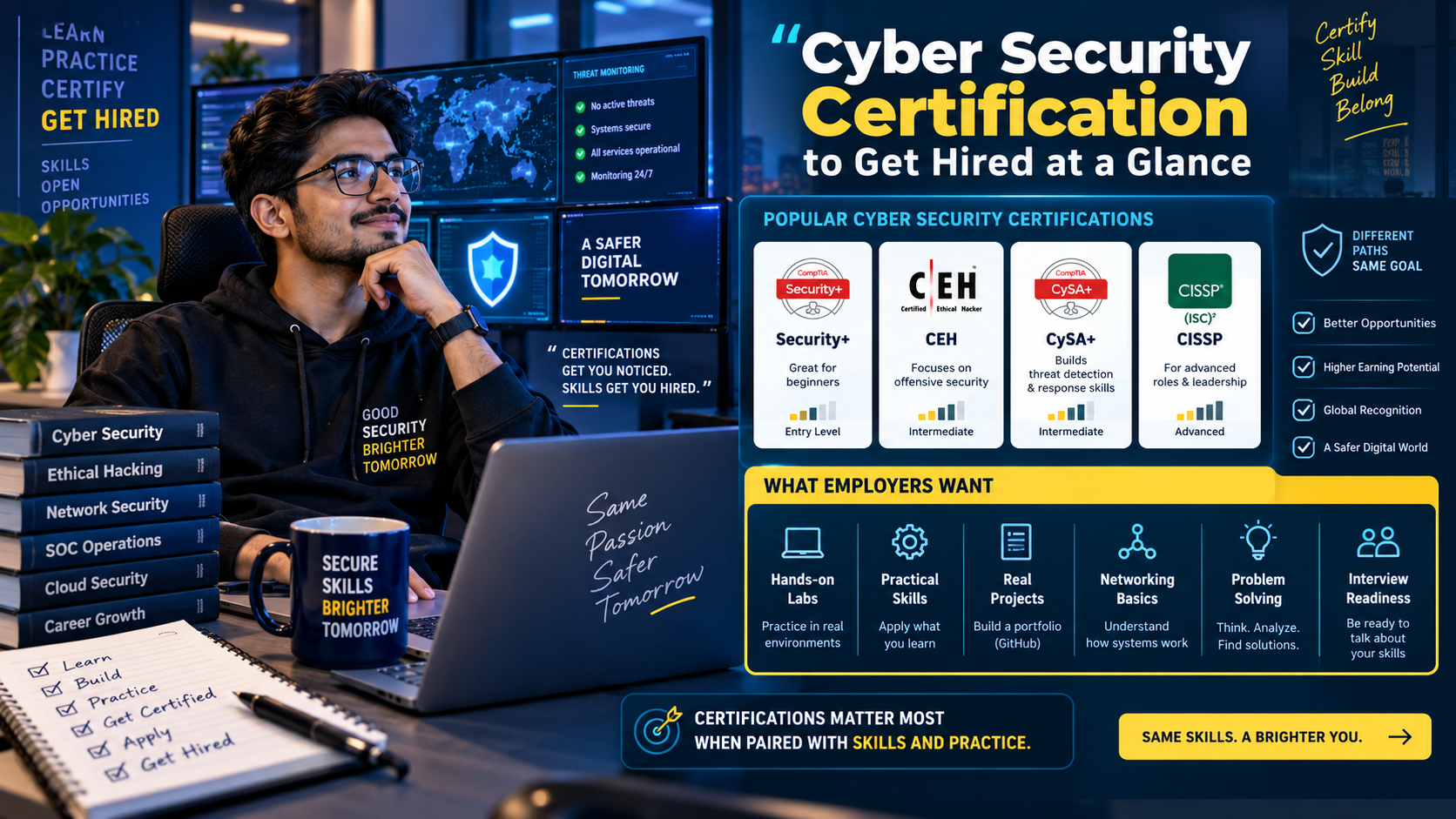
| Certification | Best for | Typical target role | Helpful background |
| Security+ | A first security credential | Junior security analyst, security support | Some IT support or networking |
| CySA+ | Threat detection and analysis | SOC analyst, threat analyst | Security+ level knowledge and alert handling |
| PenTest+ | Offensive security | Junior penetration tester, vulnerability analyst | Networking, Linux and scripting basics |
| PCNSA | Palo Alto firewalls | Network security engineer, firewall administrator | Networking fundamentals |
| AZ-500 | Azure security | Cloud security engineer, Azure security administrator | Azure and identity experience |
If You’re Still Torn: Three Decision Rules
- Follow the ads. If most of the ads for your target role name the same certification, start there.
- Follow your experience. Build on what you already have. Azure admin work points to AZ-500, networking points to PCNSA, and general help desk experience points to Security+.
- Follow your timeline. If you need to move soon, choose the certification most common in entry-level ads for your role, then add depth later.
How Hiring Managers Read a Certified Resume
Managers skim, so make the important details easy to find. They tend to look for the certification first, then the tools you’ve touched, then evidence of doing rather than studying. A tidy resume puts the certification and its status near the top, follows it with two or three projects and names tools in full, such as Microsoft Sentinel or Palo Alto firewalls.
Check the validity of your credential too. Many certifications need renewal or continuing education to stay current, so an expired one can raise questions. If you’re unsure how long yours lasts, check with the certifying body before you list it. And keep every claim honest. Security teams guard sensitive systems, and a resume that overstates experience can end an application quickly.
The Australian Factor: Clearances, Citizenship and Government Roles
This is the part international guides miss. A lot of sought-after security work in Australia sits with government, defence and their suppliers, and those roles often require a security clearance. The Australian Government Security Vetting Agency (AGSVA) grants clearances at four levels: Baseline, Negative Vetting 1, Negative Vetting 2 and Positive Vetting.
Two facts matter for job seekers. Individuals can’t sponsor their own clearance, because a government agency or business has to do it. And most clearances require Australian citizenship. So a certification can make you a stronger candidate for these roles, but it can’t replace eligibility. The AGSVA applicant guide explains the levels and timeframes.
It also pays to know the Australian Signals Directorate’s Essential Eight, the baseline mitigation strategies covering patching, multi-factor authentication, restricted administrative privileges, application control, Office macros, user application hardening and backups. Discussing them in an interview shows local awareness that a generic certificate list can’t.
Cyber Security Jobs by City: What Employers Want Where
Priorities shift a little depending on where you’re job hunting. Here’s a general guide, with links to local training options:
- Sydney: finance, consulting and technology employers hire analysts and cloud security staff. See cyber security training in Sydney.
- Melbourne: finance, healthcare, technology and state government all recruit. See cyber security training in Melbourne.
- Brisbane: a growing technology, resources and public sector market. See cyber security training in Brisbane.
- Perth: mining, energy and resources organisations value security skills. See cyber security training in Perth.
- Adelaide: defence industry and public sector employers, where clearance may matter. See cyber security training in Adelaide.
- Canberra: federal agencies, where citizenship and clearance are often decisive. See cyber security training in Canberra.
Courses run in person in selected cities and live online across Australia. See our locations page for details.
Entry-Level Cyber Security Jobs: A Realistic Starting Point
“Entry-level” means different things in cyber security. Some ads under that label still want a couple of years of IT experience, because employers often see security as a second step after systems or networking. That’s frustrating, but it shapes the best plan. Many people start in IT support, systems administration or networking, add a certification, and then move across into a security analyst role.
If you have no IT background at all, choosing the cyber security certification to get hired matters less than getting a first foothold: a help desk job, an internship, a graduate program or a junior role with some security responsibility. Our sister site cybersecuritycourse.au covers beginner pathways in more detail.
Mistakes That Stop Certified Candidates Getting Hired
Even the right cyber security certification to get hired can’t rescue an application with these problems:
- Collecting certificates before choosing a target role.
- Listing acronyms without describing what you did with the skills.
- Skipping hands-on practice because the exam felt manageable.
- Applying for senior roles that expect years of experience.
- Ignoring communication, from incident reports to stakeholder updates.
Our guide to cyber security certification mistakes goes deeper, and the certification sequencing post and top 10 certifications employers value show how the options fit together.
Your Plan for Turning a Certification Into a Job Offer
Here’s a simple five-step plan for choosing and using the cyber security certification to get hired:
- Pick a role first. Use the 20-ad tally to see what employers in your target role really ask for.
- Choose the matching certification. Use the table above rather than the most popular option.
- Build two or three lab projects. Investigate sample alerts in a SIEM, write up a vulnerability assessment of a practice environment you own, or document hardening steps aligned to the Essential Eight.
- Rewrite your resume around outcomes. Put the certification near the top, projects beneath it, and tool names in full.
- Practise scenario answers. Rehearse how you’d triage an alert or explain a phishing incident to a manager.
Frequently Asked Questions
Which cyber security certification to get hired is best for beginners?
For most beginners it’s Security+, because it’s vendor-neutral and widely recognised for entry-level security work. If you already know you want a specific path, such as Azure security or penetration testing, start with the matching certification instead.
Can I get a cyber security job with just Security+?
Sometimes, particularly for junior roles when you also have IT experience and some lab evidence. On its own it’s often not enough, so pair it with practical projects and a resume that shows what you’ve done.
Is CISSP a good certification to get hired at entry level?
Not usually. CISSP expects several years of relevant experience, so it suits people moving into senior or management roles rather than those starting out.
Do I need a degree for a cyber security job in Australia?
It depends on the employer. Some, particularly government agencies and large corporates, prefer a degree, while many others weigh certifications, experience and practical evidence heavily. Check each ad and use your projects to close any gap.
How long does it take to become hireable?
It depends on your starting point. Someone with IT support experience can move faster than someone starting from scratch, and the biggest variable is how much hands-on practice you build alongside study.
Are vendor-neutral certifications better than vendor-specific ones?
Neither is better in general. Vendor-neutral certifications such as Security+ and CySA+ show broad knowledge and travel across employers. Vendor-specific ones such as PCNSA or AZ-500 shine when the employer uses that technology. Let the ads for your target role decide.
Choose the Certification That Gets You Hired
The best cyber security certification to get hired is the one that fits your target role, your background and the market where you live. Pick the role, match the certification, back it with real practice, and check your eligibility for government work early.
If you’d like help choosing, speak to a course advisor on 1300 649 299 or send an enquiry. You can also browse all cyber security certification courses, visit cybersecuritycourse.au for beginner pathways, explore Logitrain or check our FAQs.