



If you’re comparing penetration tester salary Australia figures before deciding whether to invest in CompTIA PenTest+, you’re asking exactly the right question before you spend anything. Penetration testing is one of the better-paid corners of cybersecurity in Sydney, Melbourne, Brisbane, Perth, Adelaide and Canberra, but the certification only pays off if it matches where you are in your career. This guide breaks down the real 2026 salary numbers and gives you a straight answer on PenTest+.
Penetration Tester Salary in Australia 2026: The Numbers
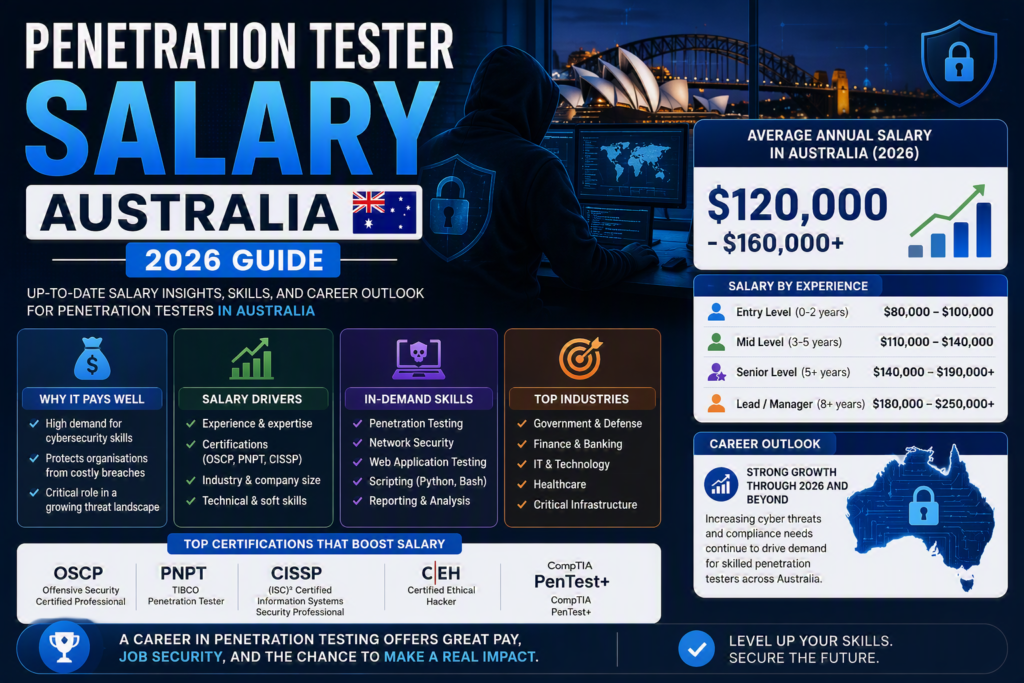
According to SEEK’s current salary data, the average penetration tester salary in Australia sits between AUD $110,000 and $130,000. Other sources show a similar band with more spread at the top: Indeed and SalaryExpert both report averages closer to AUD $130,000–$148,000 in higher-cost markets like Melbourne, while entry-level figures start noticeably lower across all sources.
Penetration testing consistently pays above the broader IT and even broader cybersecurity average, largely because the skill set is specialised, hands-on, and directly tied to measurable risk reduction for employers.
Penetration Tester Salary by Experience Level
- Entry-level (0–2 years): roughly AUD $63,000–$85,000 — often starting from an IT support, network administration or general security analyst background
- Mid-level (2–5 years): roughly AUD $105,000–$135,000
- Senior (5+ years): roughly AUD $135,000–$190,000, with contractors and consultants at the top end regularly exceeding $900 per day
The jump from entry to mid-level tends to track certification and demonstrated engagement experience closely — this is a field where employers want to see evidence of hands-on testing ability, not just theory.
Penetration Tester Salary by City
- Sydney: among the highest-paying markets, driven by financial services and a concentration of security consultancies — see cybersecurity training in Sydney
- Melbourne: consistently strong, with SalaryExpert data placing Melbourne slightly above the national average — see cybersecurity training in Melbourne
- Brisbane: growing steadily alongside the region’s expanding tech and government-services sector — see cybersecurity training in Brisbane
- Perth: solid demand from resources-sector operational technology security — see cybersecurity training in Perth
- Adelaide: competitive rates in defence and government-adjacent penetration testing roles — see cybersecurity training in Adelaide
- Canberra: often commands a premium for cleared roles in federal government and defence contracting — see cybersecurity training in Canberra
What Is CompTIA PenTest+?
CompTIA PenTest+ is an intermediate-level certification covering the full penetration testing lifecycle: planning and scoping an engagement, legal and compliance considerations, vulnerability scanning, exploitation, and — critically — writing a professional report that communicates findings to both technical and non-technical stakeholders. See the full CompTIA PenTest+ course details for the complete exam-aligned curriculum.
CompTIA PenTest+ Cost in Australia
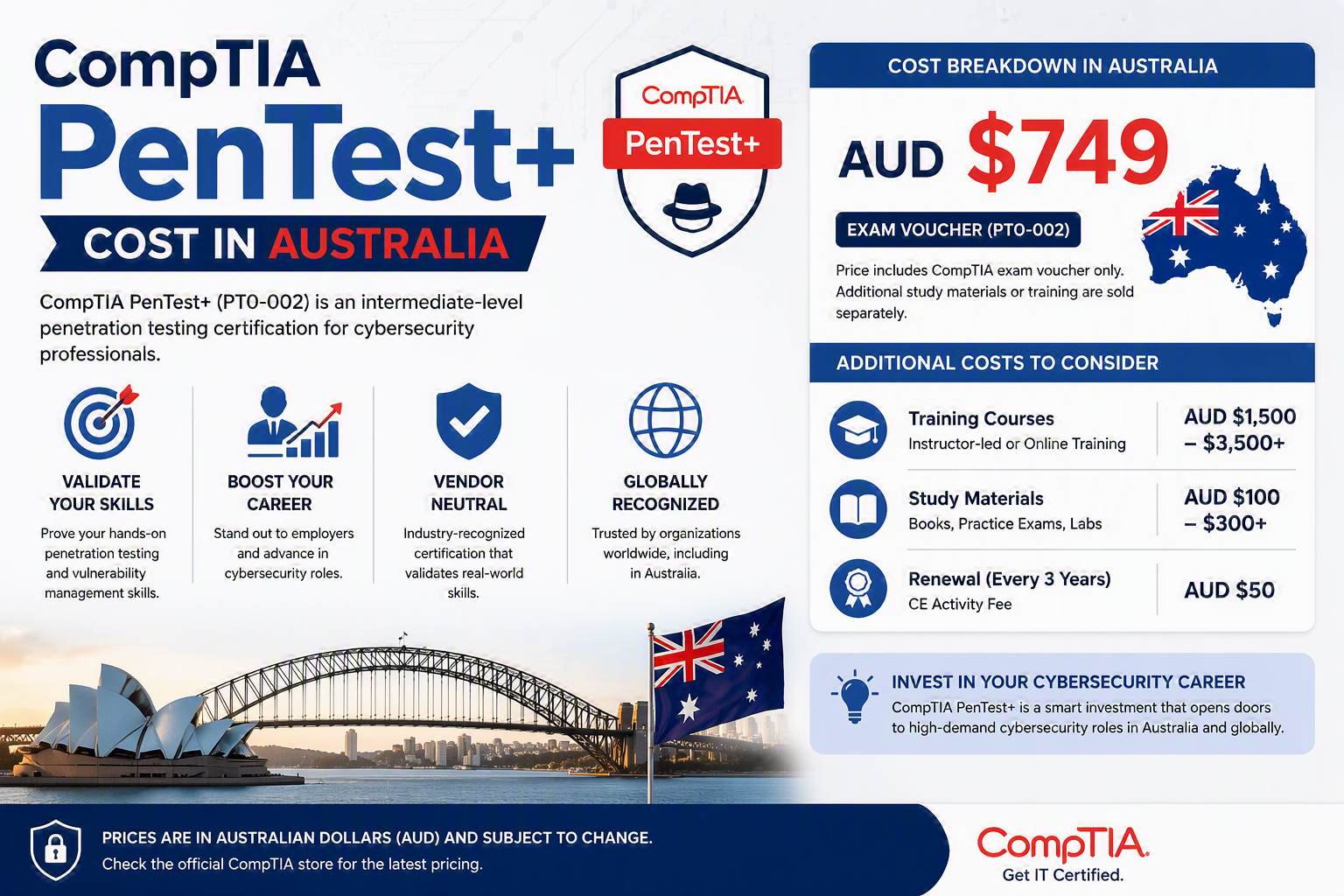
- Exam voucher: CompTIA’s official pricing sits around USD $425–$439, which typically converts to roughly AUD $650–$680 depending on exchange rates and GST
- Instructor-led training: around AUD $1,849 for a structured, hands-on course covering the full exam blueprint, delivered across Melbourne, Sydney, Brisbane, Adelaide, Canberra and Perth
- Self-study route: official CompTIA study materials and third-party practice tests typically add AUD $50–$300 on top of the exam voucher
Because exam pricing changes periodically, it’s worth checking the official CompTIA PenTest+ page for current fees before booking.
Is CompTIA PenTest+ Worth It? Weighing the Evidence
The evidence for PenTest+ paying off is genuinely stronger than for many entry-level certifications, largely because it sits at exactly the point where employers start requiring formal validation of hands-on skills:
- Employer preference for the certification is high among roles specifically advertised as penetration testing or ethical hacking positions
- It bridges the gap between foundational security certifications (like Security+) and advanced offensive-security credentials (like OSCP), making it a logical mid-career step rather than a standalone bet
- It’s significantly cheaper than alternatives like CEH, while covering comparable ground for most entry-to-mid-level penetration testing roles
- It doesn’t require years of documented experience to sit, unlike more advanced security credentials
Where it’s less clearly worth it: if you’re brand new to IT with no networking or security fundamentals at all, PenTest+ assumes baseline knowledge (CompTIA recommends Security+ or equivalent first). Jumping straight to PenTest+ without that foundation usually means a harder, longer study process for a lower first-attempt pass rate.
Skills You’ll Gain in a PenTest+ Course
- Planning and legally scoping a penetration testing engagement
- Vulnerability scanning and analysis using industry-standard tools
- Exploiting network, wireless, web application and local host vulnerabilities in controlled environments
- Post-exploitation techniques and Active Directory attack paths
- Writing a professional penetration testing report and communicating findings to stakeholders
PenTest+ vs Other Penetration Testing Certifications
PenTest+ sits in the middle of the penetration testing certification landscape. Compared to CEH, it’s generally considered more hands-on and noticeably cheaper. Compared to OSCP, PenTest+ is more accessible for candidates earlier in their career, while OSCP is widely regarded as the harder, more advanced practical benchmark that senior penetration testers pursue later. Many professionals follow a CompTIA Security+ → PenTest+ → OSCP pathway, treating PenTest+ as the credential that opens the door to dedicated penetration testing roles rather than the final destination.
PenTest+ Training Options Across Australia
Instructor-led CompTIA PenTest+ training is available in Melbourne, Sydney, Brisbane, Adelaide, Canberra and Perth, with live virtual delivery also covering Hobart and other regional areas. Browse the full course catalogue to see how PenTest+ fits alongside Security+ and CySA+ on a longer certification roadmap.
Frequently Asked Questions
What is the average penetration tester salary in Australia?
According to SEEK, the national average sits between AUD $110,000 and $130,000, with entry-level roles starting around $63,000–$85,000 and senior roles reaching $135,000 or more.
Is CompTIA PenTest+ worth it in 2026?
For candidates who already have foundational security knowledge (Security+ level or equivalent) and want to move into a dedicated penetration testing role, yes — it’s a recognised, relatively affordable credential that employers actively look for in job ads.
How much does the CompTIA PenTest+ exam cost in Australia?
Budget roughly AUD $650–$680 for the exam voucher alone, with instructor-led training adding around AUD $1,849 if you choose a structured course over self-study.
Do I need Security+ before PenTest+?
It’s not a strict requirement, but CompTIA recommends Security+ or equivalent foundational knowledge first — attempting PenTest+ without that base typically means a longer, harder study process.
Is PenTest+ better than OSCP for beginners?
For most people newer to penetration testing, yes — PenTest+ is more accessible and structured around exam objectives, while OSCP is a harder, more advanced practical certification typically pursued once you already have some hands-on testing experience.
Final Thoughts: Penetration Tester Salary and PenTest+ in 2026
Penetration testing remains one of the stronger-paying specialisations in Australian cybersecurity, and CompTIA PenTest+ is a genuinely reasonable investment for candidates at the right stage — past the absolute basics, but not yet ready for an advanced practical exam like OSCP. Get the fundamentals down first, then let PenTest+ do its job as the credential that opens the door to dedicated testing roles. Ready to start? Get in touch or explore the full PenTest+ course details.