


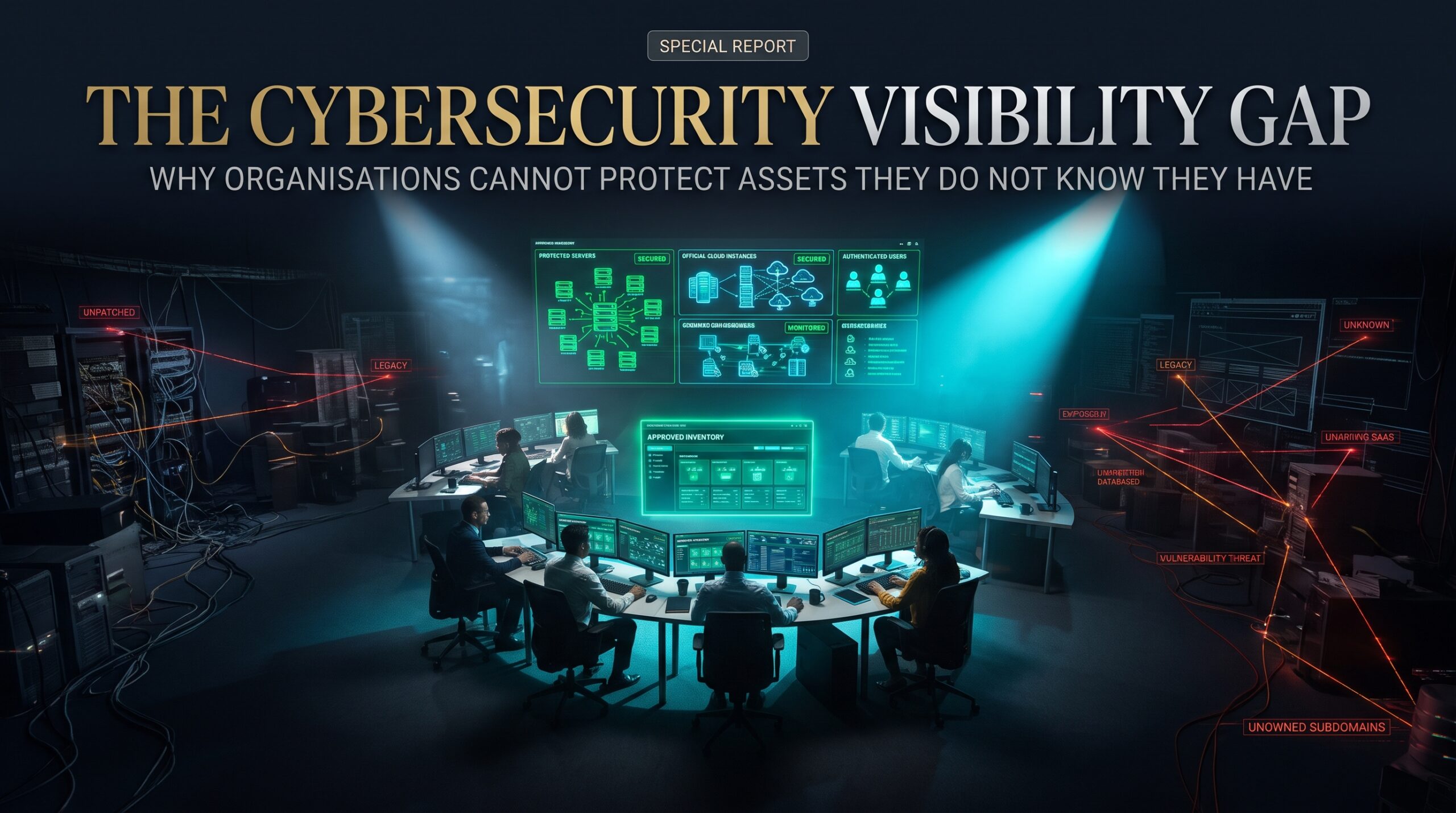
The cybersecurity visibility gap is the distance between what an organisation believes it owns and what is actually connected to its networks, cloud accounts and supplier ecosystem. It is one of the most expensive blind spots in security, because every control you pay for, from endpoint detection to multi-factor authentication, only protects the assets it can see. Anything outside that picture is exposed by default.
Here is the uncomfortable part. Most Australian security teams are not short on tools. They are short on certainty. Ask a CIO in Sydney how many internet-facing systems the business runs and you will usually get a confident number. Run an external scan and you will often get a different one. That difference is the cybersecurity visibility gap, and attackers are very good at finding it before you do.
This guide explains where the gap comes from, what it costs, how to close it step by step, and which skills and certifications help you do that work professionally. If you are a business owner, an IT manager or someone building a security career, the same principle applies: you cannot defend an asset you do not know exists.
What Is the Cybersecurity Visibility Gap?
Put simply, it is the difference between your documented environment and your real one. The documented version lives in a spreadsheet, a CMDB or someone’s memory. The real version includes every laptop, server, cloud workload, SaaS subscription, API, domain, subdomain, smart device and contractor account that can touch your data, whether or not anyone approved it.
Security people usually describe three layers of visibility:
- Known and managed: assets that are inventoried, patched, monitored and owned by a named person.
- Known but unmanaged: assets the team has heard of but that sit outside patching, logging or backup because nobody has had the time.
- Unknown: assets nobody has recorded at all, such as a forgotten test server, a marketing microsite or an old VPN gateway left running after a project ended.
The first group is where your security budget goes. The third group is where many breaches begin. A cybersecurity visibility gap is rarely one dramatic failure. It is hundreds of small, reasonable decisions that were never written down.
Why You Cannot Protect Assets You Do Not Know You Have
Every core security activity depends on an accurate asset list. Patching needs to know which systems exist. Monitoring needs to know which logs to collect. Access reviews need to know which accounts are attached to which services. Incident response needs to know what to isolate. A cybersecurity visibility gap makes each of those activities fail quietly in the same place.
This is why the major frameworks start here. The CIS Critical Security Controls put inventory and control of enterprise assets first and software assets second. The NIST Cybersecurity Framework places asset management inside its Identify function. And the Australian Cyber Security Centre’s Essential Eight assumes you can patch, restrict and back up the systems that matter, which only works if you can list them.
There is a regulatory angle too. Under the Notifiable Data Breaches scheme, organisations must assess whether a breach is likely to cause serious harm. That assessment is far harder when you cannot say where personal information is stored or which system was touched. Poor visibility turns a manageable incident into a slow, expensive investigation.
Where the Cybersecurity Visibility Gap Comes From
Almost nobody creates a visibility problem on purpose. It builds up as the business moves faster than the security process. These are the usual sources:
| Source of unknown assets | How it appears in real life | Why it stays hidden |
| Shadow IT | A team signs up to a file-sharing or project tool with a company email | No procurement record, so security never hears about it |
| Cloud sprawl | Developers spin up storage buckets, VMs and test databases in Azure or AWS | Resources outlive the project and the person who created them |
| Mergers and acquisitions | Inherited domains, networks and admin accounts arrive in bulk | Integration plans focus on finance and people before security |
| Forgotten internet-facing systems | An old staging site, VPN or remote desktop service is still reachable | Not on the inventory, so it is never patched or monitored |
| Third parties and SaaS | Suppliers hold data or hold access into your environment | Contracts list services, not the assets behind them |
| IoT and operational technology | Cameras, printers, building controls and industrial sensors join the network | They cannot run an agent, so standard tools miss them |
| Remote and personal devices | Staff work from unmanaged laptops and phones | Device enrolment is optional or inconsistent |
Notice that none of these look like negligence in the moment. Each one made sense to the person who did it. The problem is that the sum of them produces a cybersecurity visibility gap that no single person can see.
The Real-World Cost of Unknown Assets
When an incident hits, the first questions are always the same. What was affected? What data was on it? Who owns it? How did the attacker get in? A team with good visibility can answer in minutes. A team with a cybersecurity visibility gap spends days reconstructing the answer while the attacker keeps moving.
Several large Australian incidents in recent years, including the 2022 Optus and Medibank cases, put a spotlight on how exposed systems and poorly governed data can become the entry point or the amplifier. Public reporting on Optus pointed to an internet-reachable interface that should not have been open, and the commentary that followed was less about clever attackers and more about basic exposure and oversight. The lesson for every organisation is practical: an asset you have forgotten is an asset an attacker can still use.
Attackers also use your cybersecurity visibility gap, mapping targets with the same logic as defenders. The MITRE ATT&CK framework lists reconnaissance and initial access techniques that begin with finding exposed services, credentials and misconfigurations. If they can enumerate your environment faster than you can, you are already behind.
Warning Signs Your Organisation Has a Cybersecurity Visibility Gap
You do not need an expensive audit to spot the early symptoms. Be honest about how many of these apply:
- Your asset register is updated once a year, or only when an audit is coming.
- Different teams give you different answers about how many servers or cloud subscriptions exist.
- Vulnerability scans keep finding systems nobody recognises.
- Endpoint detection coverage is reported as a percentage, but nobody can say what it is a percentage of.
- Staff leave and their accounts, devices and tool subscriptions stay active.
- Security finds out about new SaaS tools from the invoice, not from the request.
Two or three of these is common. Four or more means the cybersecurity visibility gap is probably wider than leadership believes, and it is worth treating as a priority rather than a clean-up task.
How to Close the Cybersecurity Visibility Gap: A Practical Plan
Closing the gap is not a one-off project. It is a habit supported by tooling. The sequence below works for a small business and scales to a large enterprise.
Step 1: Agree what counts as an asset
Start with a broad definition: hardware, software, cloud resources, data stores, identities, domains, certificates, APIs and third-party services. If your definition only covers laptops and servers, your inventory will miss most of the modern attack surface.
Step 2: Discover continuously, not annually
Use automated discovery across the network, cloud APIs, DNS records and certificate transparency logs. External attack surface management tools look at your organisation the way an attacker does, from the outside in. Running discovery weekly or daily narrows the cybersecurity visibility gap far faster than a quarterly spreadsheet exercise.
Step 3: Centralise the results
Pull findings into one source of truth, whether that is a CMDB, a cyber asset attack surface management (CAASM) platform or a well-governed register. Reconcile it against your identity provider, endpoint manager and cloud accounts so every cybersecurity visibility gap becomes obvious.
Step 4: Give every asset an owner
An asset without an owner will not be patched, which keeps the cybersecurity visibility gap wide open. Record a business owner and a technical owner for each system, and make it a rule that new assets cannot go live without one.
Step 5: Rank by criticality and data sensitivity
Not everything needs the same attention. Tag assets by business impact, the data they hold and how exposed they are to the internet. This is what lets a small team focus on the ten systems that matter instead of drowning in ten thousand findings.
Step 6: Connect visibility to detection and response
An inventory is only useful if it feeds your monitoring. Make sure every critical asset sends logs to your SIEM, such as Microsoft Sentinel or Splunk, and has an endpoint agent where one is possible. Missing telemetry is itself a finding.
Step 7: Measure the gap and report it
Track a few simple numbers: percentage of assets with an owner, percentage with endpoint coverage, number of internet-facing assets not on the register, and average time to discover a new asset. Reporting these to leadership turns the cybersecurity visibility gap from an abstract worry into something that can be managed and funded.
Tools and Frameworks That Help Close the Visibility Gap
| Need | Example platforms and standards | What it gives you |
| Asset discovery and vulnerability scanning | Tenable, Qualys, Rapid7, Nmap | Live view of devices, services and known weaknesses |
| Endpoint visibility | Microsoft Defender for Endpoint, CrowdStrike Falcon | Coverage, telemetry and response on managed devices |
| Cloud posture | Microsoft Defender for Cloud, AWS Security Hub | Misconfigurations and unmanaged cloud resources |
| Log correlation | Microsoft Sentinel, Splunk | Central detection across assets and identities |
| External exposure | Shodan, attack surface management platforms | What the internet can see about you |
| Control frameworks | CIS Controls, NIST CSF, ACSC Essential Eight, ISO 27001 | A structure for governance and audit evidence |
Tools are only half the answer to a cybersecurity visibility gap. Someone has to configure them, read the output and turn it into decisions, which is why asset visibility is now a core part of security training.
Skills and Certifications That Build Visibility Capability
Closing a cybersecurity visibility gap is hands-on work, and employers increasingly ask for vendor-recognised proof that you can do it. These are the certifications most closely tied to asset discovery, vulnerability management and detection:
| Certification | How it relates to visibility | Best suited to |
| CompTIA Security+ | Risk, asset management, network security and core controls | Beginners and career changers entering security |
| CompTIA CySA+ | Vulnerability management, threat detection and analytics | SOC analysts and vulnerability analysts |
| CompTIA PenTest+ | Finding exposed services and weaknesses the way an attacker would | Testers and red-team aspirants |
| Microsoft AZ-500 | Securing and governing Azure resources, identities and networks | Cloud and Azure security engineers |
| Microsoft SC-200 | Sentinel, Defender and security operations workflows | SOC and detection engineers |
| Palo Alto PCNSA | Network traffic visibility and policy enforcement | Network security administrators |
If you are starting from scratch, our guide on how to start a cyber security career in Australia with no IT background lays out a realistic path, and the Logitrain live online classes let you train with certified instructors without leaving your city. You can compare every option on the Cyber Security Certifications course page.
How the Cybersecurity Visibility Gap Plays Out Across Australian Cities
The gap looks different depending on where you work and what your industry holds. Here is how it commonly shows up in the main capitals:
| City | Typical environment | Where visibility problems tend to appear |
| Sydney | Banking, fintech, insurance and large enterprise | Complex cloud estates, acquisitions and heavy third-party use |
| Melbourne | Healthcare, education, telecommunications and professional services | Sensitive personal data spread across many SaaS tools |
| Brisbane | Logistics, resources, health and fast-growing mid-size business | Rapid growth outpacing documentation and asset ownership |
| Perth | Mining, energy and resources with remote sites | Operational technology and remote infrastructure outside normal monitoring |
| Adelaide | Defence supply chain, advanced manufacturing and health | Supplier access and contractor devices |
| Canberra | Federal government and its contractors | Strict compliance expectations and legacy systems alongside new cloud services |
Whichever city you are in, demand for people who can shrink a cybersecurity visibility gap by discovering, classifying and monitoring assets keeps growing. Professionals with Security+, CySA+ or Azure security credentials are well placed for analyst, engineer and governance roles in Sydney, Melbourne, Brisbane, Perth, Adelaide and Canberra, and many of those employers accept remote or hybrid arrangements.
Frequently Asked Questions About the Cybersecurity Visibility Gap
What is the cybersecurity visibility gap?
It is the difference between the assets an organisation thinks it has and the assets that actually exist across its networks, cloud services, devices and suppliers. Anything in that difference is likely to be unpatched, unmonitored and unowned.
How is asset inventory different from attack surface management?
An asset inventory records what you know about internally. Attack surface management continuously discovers what is reachable from the outside, including systems you did not know were exposed. The two work best together.
How often should an organisation update its asset inventory?
As close to continuously as your tools allow. Annual updates are too slow for cloud environments where resources appear and disappear daily. Aim for automated discovery with a regular human review of exceptions.
Is asset visibility part of the Essential Eight?
The Essential Eight does not list inventory as one of its eight strategies, but patching, application control, administrative privilege restriction and backups all depend on knowing which systems are in scope. Most practitioners treat asset visibility as the foundation underneath it.
Which certification should I study first to work on visibility problems?
CompTIA Security+ is the usual starting point because it covers risk, assets and core controls. From there, CySA+ builds vulnerability management and detection skills, and AZ-500 or SC-200 suit people working in Microsoft environments.
Final Thoughts: Close the Gap Before Someone Else Finds It
The cybersecurity visibility gap does not announce itself. It shows up as a surprise in an audit, an alert from an unfamiliar server or a breach notification. The good news is that it is one of the most fixable problems in security, because the first step is simply to look properly and write down what you find.
If you want to build the skills to do that for a living, explore the instructor-led pathways at cybersecuritycertifications.au, compare Security+, CySA+, PenTest+ and AZ-500 options, and book a live online class through Logitrain. Start with what you can see today, then keep widening the picture.