


Detection rules are the logic inside a SIEM, EDR or cloud security tool that decides what counts as suspicious and which events raise an alert. Like milk in the fridge, they have a shelf life. This is the detection rule decay problem: rules that once caught real threats slowly lose accuracy, and the dashboard stays quiet while the risk grows.
The danger is that decay looks exactly like safety. No alerts feels like no attacks. Yet a rule can go silent because the data feeding it changed, because an exclusion swallowed the signal, or because attackers moved on to techniques the rule was never written to see. This guide explains why detection rules decay, what it costs, and how security teams across Australia can keep their alerts honest.
| Quick answer
Detection rules decay because attackers, software, logs and business processes all keep changing while the rules stay still. To stop it, give every rule an owner, test it on a schedule with safe simulations, monitor your log sources, review exclusions regularly and retire rules that no longer earn their place. |
What Are Detection Rules and Why Do They Decay?
Detection rules are pre-defined conditions that analyse logs and telemetry to flag behaviour worth investigating. A rule might look for repeated failed sign-ins followed by a success, an unusual process launching a script, or data leaving the network at odd hours. They sit at the heart of any security information and event management setup.
Decay is the gradual loss of a rule’s ability to detect what it was built to detect, or the growth of noise that hides what matters. It happens for two broad reasons. The outside world changes, with new attacker techniques and tools. And the inside world changes, with new software, new log formats, new cloud services and new staff. A rule written for last year’s environment is quietly out of date in this year’s.
The Detection Rule Decay Problem: A Story Many SOC Teams Recognise
Picture a Sydney financial services firm with a busy security operations team. Two years ago, an analyst wrote a rule to flag suspicious command-line activity. It was good. It caught a real incident in its first month.
Over time, the rule generated false positives from legitimate admin scripts, so the team added exclusions. Then the endpoint agent was upgraded, and a field the rule depended on was renamed. The rule did not break loudly. It just stopped matching anything. For months, the dashboard showed zero alerts from that rule, and everyone assumed the environment was clean.
It was discovered only during a planned exercise, when a safe test activity that should have fired the alert produced nothing. Nobody had been careless. The rule had simply aged, and nothing was watching for that. (This scenario is an illustration, not a real case.)
The same pattern appears in other hidden risks we have written about, such as permission creep, where access quietly accumulates, and the machine identity blind spot, where accounts nobody owns slip out of view.
Why Detection Rules Decay: Common Causes
1. Attackers change their methods, and old detection rules fall behind
Rules built around one known tool, file hash or IP address age fast, because attackers swap them out easily. Rules built around behaviour last longer, but even those need updates as techniques evolve. The MITRE ATT&CK knowledge base is a useful reference for how adversary behaviour is catalogued and updated over time.
2. Log sources change or quietly stop feeding detection rules
A parser update, a renamed field, a new log format or a disabled agent can starve a rule of the data it needs. The rule is still active, but it is looking at nothing. This is one of the most common and least visible causes of decay.
3. Exclusions pile up inside detection rules
Every false positive tempts someone to add an exception. A few are healthy. Hundreds, added by different people over several years and never reviewed, can carve holes big enough to hide real activity.
4. The business environment moves on
Cloud migrations, new SaaS tools, remote work and mergers all change what normal looks like. Thresholds set for the old baseline become either too noisy or too blind.
5. Alert fatigue leads to disabled detection rules
When a rule fires constantly, analysts mute it or lower its priority. A rule that was disabled during a busy week may never be turned back on, and nobody remembers why.
6. Ownership and knowledge disappear
The analyst who wrote the rule leaves. The ticket explaining its purpose is buried. Now nobody dares to change it, and nobody can say whether it still works.
7. Vendor content updates collide with custom changes
Rule packs from vendors improve over time, but local tweaks can be overwritten or fall out of step with new versions. Teams end up unsure which version is actually running.
Cause-and-Fix Cheat Sheet for Decaying Detection Rules
Use this table to match what you see with the likely cause behind failing detection rules and a first fix.
| What you notice | Likely cause | Quick fix |
| A rule has not fired in months | Broken data source or renamed field | Check the log source and field mapping; run a safe test |
| Analysts ignore a rule | Too many false positives | Tune with narrow, documented exclusions, not broad ones |
| Coverage looks good on paper but incidents slip through | Rules not tested against real behaviour | Run regular adversary simulation and compare to coverage |
| Nobody can explain why a rule exists | Missing owner and documentation | Assign an owner and record purpose, data source and last test date |
| Rules depend on old indicators | Indicator-based logic that has aged | Rework around behaviour; expire indicators automatically |
| Alerts changed after a platform upgrade | Schema or agent changes | Add a post-upgrade regression test for key rules |
What Decaying Detection Rules Really Cost
Silent gaps in coverage
The biggest cost of decaying detection rules is invisible. A missed attack leaves no alert to prove it was missed. Teams find out through an incident, a customer complaint or an external report.
False confidence in reports
Coverage maps and monthly metrics can look excellent while half the rules behind them no longer work. Leaders make decisions on numbers that are no longer true.
Burned-out analysts
Noisy, outdated rules waste time and wear down morale. Good analysts spend their days closing pointless alerts instead of hunting real threats.
Lost digital trust
When customers, regulators and partners learn that an attack went undetected, the damage goes beyond the incident. It touches digital trust and the assets you were meant to protect. For practical guidance on logging and detection, the Australian Cyber Security Centre publishes advice at cyber.gov.au.
How to Check Whether Your Detection Rules Still Work: A Seven-Step Routine
You can audit your detection rules this week without new tools. Work through these steps in order.
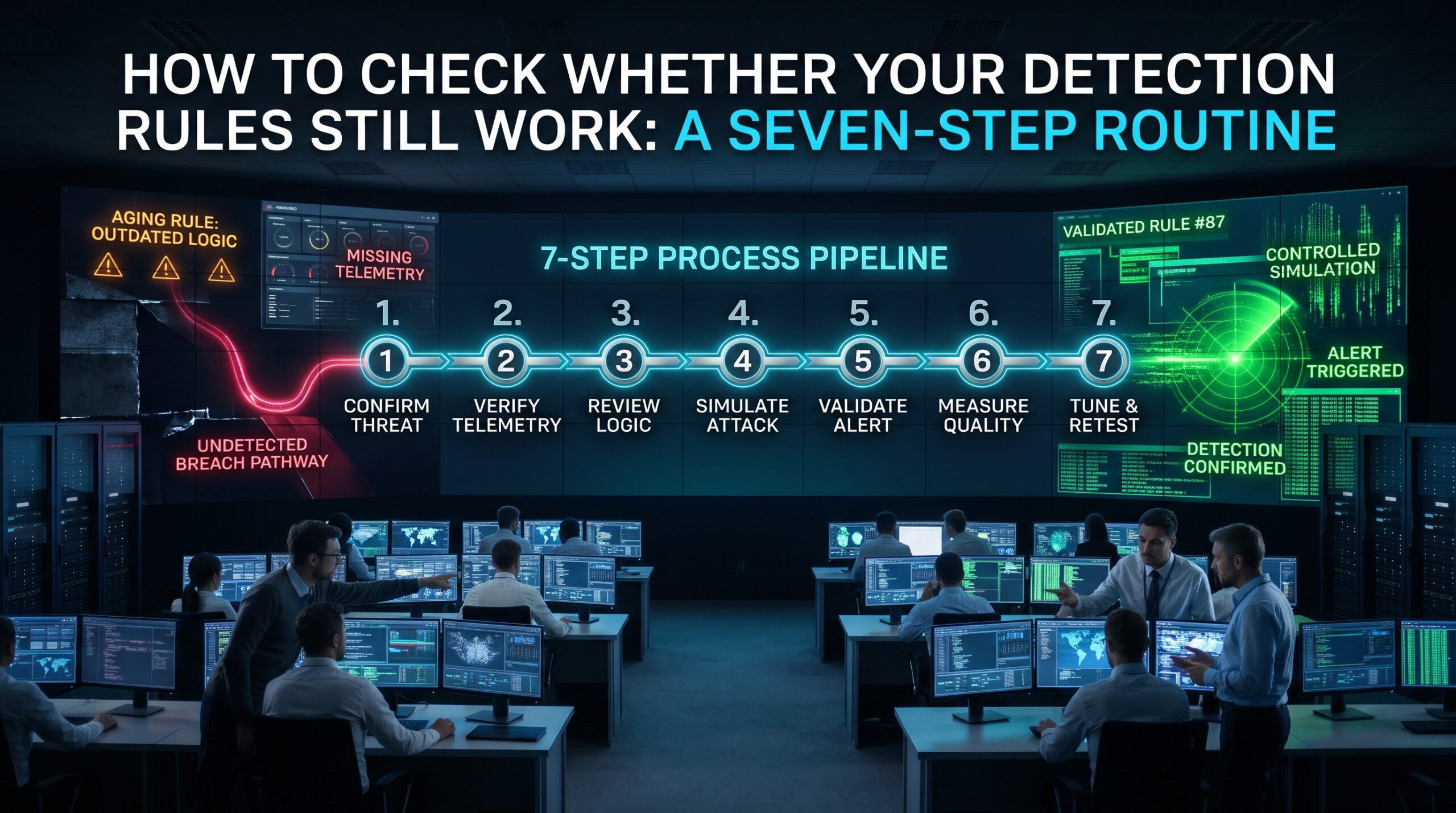
- List your detection rules and owners. Export every active rule and name a person accountable for each one. Rules without owners go to the top of the review list.
- Find the silent ones. Identify rules that have not fired for a long period. Silence is not proof of safety, so each one needs a reason.
- Check the data behind each rule. Confirm the log source is still flowing and that the fields the rule needs still exist.
- Review exclusions. Read every exception, ask why it exists, and remove the ones nobody can justify.
- Test with safe simulations. Run small, controlled tests that should trigger your key rules. Open projects such as Atomic Red Team offer lightweight tests mapped to known techniques, and they should only ever be run in approved environments.
- Compare results to your coverage map. Where a test did not trigger an alert, fix the rule or document the gap.
- Record the date and repeat. Store the last-tested date on every rule, and set a schedule to retest the important ones.
Build a Detection Rule Lifecycle That Prevents Decay
Prevention is easier than rescue. Treat detection rules like software, with a life from birth to retirement.
- Write with intent. Record what the rule detects, which data it needs, what a true positive looks like and who owns it.
- Use version control. Managing rules as code lets you track changes, review them and roll back mistakes. Open formats such as Sigma rules make rules easier to share and review across tools.
- Test before and after deployment. Every new rule should be proven against test data, and key rules should be retested after major platform changes.
- Monitor the pipeline. Set alerts for log sources that stop sending data or drop sharply in volume.
- Review on a schedule and on triggers. Do a regular review, and also review after incidents, new threat reports or infrastructure changes.
- Retire with confidence. Remove rules that no longer add value. A smaller set of healthy detection rules beats a large set of tired ones.
Detection Rule Metrics Worth Tracking
Numbers help you spot decay before an incident does. A few simple measures are enough to begin.
- Last-tested date for each important rule.
- Days since last alert, used as a prompt to investigate, not as a comfort.
- True positive rate to show whether a rule earns the analyst time it consumes.
- Log source health, such as the percentage of expected sources reporting normally.
- Coverage against attacker techniques, verified by tests rather than assumed from rule names.
- Mean time to detect in exercises, to see whether detection is getting faster or slower.
Cyber Security Certifications That Build Detection Skills
Keeping detection rules healthy takes analysis skill, platform knowledge and a clear understanding of how attackers behave. These programs at Cybersecurity Certifications map well to that work.
- CompTIA CySA+ focuses on threat detection, analysis and response, and is a natural fit for SOC analysts maintaining alerts.
- CompTIA Security+ builds an entry-level foundation across core security concepts, risk and controls.
- CompTIA PenTest+ teaches penetration testing, which helps teams understand attacker behaviour and validate whether detection actually works.
- Palo Alto PCNSA suits security engineers working with Palo Alto network security devices.
- Microsoft AZ-500 covers securing Azure environments, relevant when your detection depends on cloud telemetry.
See every option on the cyber security courses page, find answers in the FAQs, learn more about us, or read more on the Cybersecurity Certifications blog. If you are weighing up your career path, you might also enjoy The Career Resilience Advantage and The Replacement Risk.
Cyber Security Training Across Australian Cities
Security teams in every city face the same decay problem, and demand for skilled analysts is strong nationwide. Training is available live online, with classroom options in selected cities.
- Melbourne: a hub for finance, health and government security teams. See cyber security training in Melbourne.
- Sydney: banking, insurance and technology firms with large SOCs. See cyber security training in Sydney.
- Brisbane: growing resources, infrastructure and public sector demand. See cyber security training in Brisbane.
- Perth: mining and energy operators protecting critical systems. See cyber security training in Perth.
- Adelaide: defence, health and education sectors. See cyber security training in Adelaide.
- Canberra: federal agencies with strict security expectations. See cyber security training in Canberra.
Delivery options include classroom, virtual and in-house programs depending on the course and city. View all cyber security certification locations or contact the team to plan training for your whole security group.
Frequently Asked Questions About Detection Rules
What are detection rules in cyber security?
Detection rules are conditions applied to logs and security data that identify suspicious behaviour and raise alerts for analysts to investigate.
What is detection rule decay?
Detection rule decay is the gradual loss of a rule’s effectiveness caused by changing attacker methods, changing systems and logs, accumulated exclusions and missing maintenance.
How often should SIEM detection rules be reviewed?
Review important rules on a regular schedule, such as every quarter, and also after incidents, major platform changes or new threat reports. High-risk rules deserve more frequent testing.
Why has my SIEM stopped generating alerts?
Common reasons include a stopped log source, a renamed or missing field, a disabled rule, an over-broad exclusion or a platform upgrade. A safe test that should trigger the rule will show whether it still works.
What is the difference between false positives and false negatives?
A false positive is an alert for harmless activity. A false negative is real malicious activity that produces no alert. Decay increases both, but false negatives are far more dangerous because they stay invisible.
Which certification helps with detection and security operations?
CompTIA CySA+ is built around threat detection and analysis, while Security+ is a strong starting point if you are new to the field.
Do I need experience before studying these courses?
Many entry-level certifications need no prior experience, while advanced ones may expect foundational IT or security knowledge. An advisor can help you choose the right starting point.
Final Thoughts: Keep Your Detection Rules Honest
The detection rule decay problem is not a failure of effort. It is a maintenance problem hiding behind a quiet dashboard. Attackers change, systems change, people change, and detection rules that never change will eventually miss something important.
Give every rule an owner, test the important ones, watch your log sources, tidy your exclusions and retire what no longer helps. Do that, and silence on the screen starts to mean something again. If you would like structured, exam-aligned training for your team, speak with an advisor at Cybersecurity Certifications on 1300 649 299, or explore the full course list to find your starting point.