


Security control effectiveness is the question every board, auditor and insurer eventually asks, usually at the least convenient moment: “How do we know our controls actually work?” And the honest answer in many organisations is a pause. There’s a policy. There’s a tool that was installed two years ago. There’s an audit report from last year. What there isn’t is clear, current proof that the control would stop, or at least detect, the thing it was bought to stop.
This is the security evidence problem. It isn’t about being careless. Most security teams work hard and have real controls in place. The trouble is that having a control and proving it works are two very different jobs, and only the first one tends to get funded. This guide explains why the gap exists, what it costs, and how Australian organisations can improve security control effectiveness with evidence they can defend.
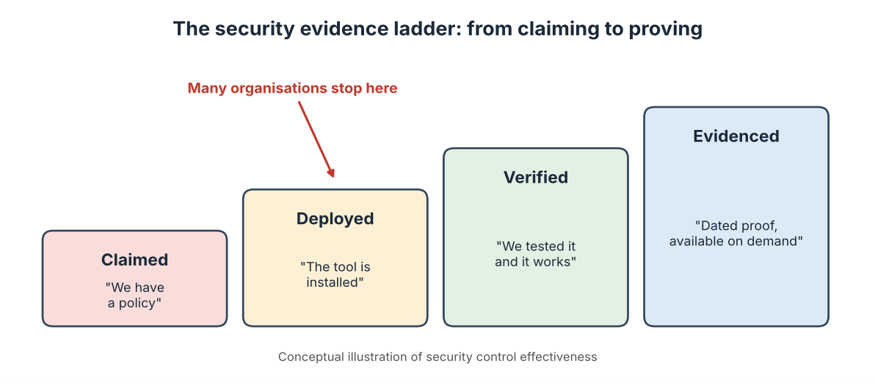
Image alt text: Security control effectiveness diagram showing the ladder from claimed controls to evidenced controls
What Is the Security Evidence Problem?
A security control is any safeguard that reduces risk: multi-factor authentication, endpoint protection, network segmentation, backups, access reviews, logging, and so on. Security controls can fail in three different ways. They can be badly designed, they can be designed well but never properly deployed, or they can be deployed correctly and then slowly stop working as systems and people change.
Security control effectiveness is the measure of whether a control actually does its job in your real environment, not in the vendor’s brochure. The security evidence problem is the inability to demonstrate that, with facts. Evidence means something more specific than “we believe so”. Good evidence is dated, repeatable, tied to a specific risk and easy to retrieve when somebody asks for it.
If you can’t produce that evidence, you don’t have assurance. You have optimism.
Why Organisations Struggle to Prove Their Controls Work
Weak security control effectiveness usually traces back to a few repeating patterns, and the causes are surprisingly consistent from one organisation to the next.
1. “Deployed” gets confused with “working”
A tool can be installed on every device and still be misconfigured, switched to monitor-only mode or weakened by a long list of exclusions. A dashboard that says 100 per cent coverage may only mean the agent is present, not that it is detecting anything. Without testing, nobody finds out until an incident does the testing for you. Installing a tool is not the same as proving security control effectiveness.
2. Audits capture a moment, not a trend
Many reviews rely on questionnaires, interviews and screenshots taken on a given day. That’s useful, but it only proves the control looked right on that day. Systems change weekly. A clean report in March says very little about October, and point-in-time reports can’t show security control effectiveness over a full year.
3. Evidence is scattered everywhere
Proof of a control is often spread across tickets, spreadsheets, inboxes, vendor portals and the memory of one long-serving engineer. When an audit arrives, people spend days reconstructing evidence, and the result varies depending on who gathers it.
4. Controls drift over time
Settings get changed for a project and never changed back. Exceptions pile up. Accounts collect extra access, a pattern we describe in our article on permission creep. Detection logic ages as attackers change tactics, as explained in our guide to detection rule decay. A control that worked at launch can quietly lose strength, because security control effectiveness decays unless somebody keeps checking it.
5. You can’t test what you can’t see
If you don’t have a reliable list of assets, you can’t be sure a control covers all of them. That’s the cybersecurity visibility gap at work, and it undermines every coverage figure you report. Non-human accounts add to the problem, which we explore in our piece on the machine identity blind spot.
6. Alerts drown the signal
Even when detection controls are working, it can be hard to show it. When thousands of warnings arrive each day, nobody can say with confidence that a serious one would stand out. Our article on security alert overload covers this in depth.
7. Nobody owns assurance
Security teams often build the controls, operate them and report on them. That’s convenient, but it means they mark their own homework. Without a clear owner for control testing and a degree of independent review, evidence tends to be optimistic by default. Security control effectiveness needs an owner, just like any other business outcome.
Compliance Is Not the Same as Security Control Effectiveness
Frameworks are a helpful starting point. Standards such as ISO/IEC 27001 and the NIST Cybersecurity Framework give organisations a structured way to choose and organise controls. In Australia, the Australian Cyber Security Centre publishes the Essential Eight, a set of mitigation strategies with a maturity model, and you can find its guidance on the cyber.gov.au website. Regulated financial institutions also face expectations from APRA, including a requirement under its information security standard CPS 234 to test the effectiveness of their controls.
But a framework tells you which controls to have. It doesn’t, by itself, prove they work. An organisation can tick every box on a checklist and still discover during an incident that a key control didn’t behave as assumed. Security control effectiveness is what turns a compliance exercise into real assurance.
The Cost of Not Being Able to Prove It
Unproven security control effectiveness carries costs that rarely appear on a risk register:
- Surprise incidents. You find out a control failed when an attacker or a penetration tester shows you.
- Slow, painful audits. Teams burn days rebuilding evidence that should have been ready.
- Questionnaire fatigue. Customers, insurers and partners ask for proof, and unclear answers can delay deals or raise premiums.
- Wasted spend. You may be paying for tools that aren’t doing what you assume, or for duplicates you don’t need.
- Weak board confidence. Leaders can’t make sensible risk decisions if the information they receive is vague.
There’s also a trust cost. Customers expect organisations to protect their data and to be able to show how. As we discuss in our article on digital trust, that confidence is hard to build and quick to lose.
Warning Signs You Can’t Prove Your Controls Work
You don’t need an audit to spot weak security control effectiveness. Watch for these signs:
- Control coverage is reported as a percentage, but nobody tests whether the control triggers.
- Audit preparation involves a scramble for screenshots.
- Nobody can say when a key control was last tested, or what happened.
- Exceptions and exclusions keep growing without a regular review.
- Security reports describe activity (patches applied, alerts closed) rather than outcomes.
- Different people give different answers to the same assurance question.
How to Prove Security Controls Work: A Practical Plan
Building evidence doesn’t require a huge programme. It requires a consistent habit of testing and recording. Here’s a plan for improving security control effectiveness that most security teams can start on:
- List your key controls and the risks they address. Start with the controls that matter most, such as identity, endpoints, email, backups and logging. Link each one to a specific risk or threat.
- Define what “working” means. For each control, write a simple test: what should happen, and how would you know? Without a pass-or-fail definition, you can’t produce evidence.
- Test regularly, not only at audit time. Use configuration checks, penetration testing, controlled attack simulations and restore tests. Mapping tests to the MITRE ATT&CK framework helps you see which techniques you can actually detect.
- Test detection, not just prevention. It’s not enough to block known bad activity. Check that your alerts fire, reach the right people and lead to action.
- Automate evidence collection where you can. Scheduled reports and logs beat screenshots, because they’re consistent, timestamped and repeatable.
- Keep evidence in one place. For each test, record the date, owner, method, result and any follow-up. A single, searchable record saves enormous time later.
- Assign owners and add independent review. Every control needs a named owner. Where risk is high, have someone outside the team that runs the control check the evidence.
- Fix, then retest. A failed test isn’t the end of the story. Close the gap, run the test again and record the improvement.
- Report confidence in plain language. Give leaders a short summary of which controls are proven, which are unproven and which failed, rather than a long list of technical metrics.
What Good Security Evidence Looks Like
The difference between a claim and evidence is often small in wording but large in value. Here are a few examples:
| The claim | The evidence behind it |
| “MFA is enforced.” | A dated report of accounts without MFA, a list of approved exceptions, and a test showing sign-in from an unmanaged device is blocked. |
| “All endpoints are protected.” | Coverage compared against the asset inventory, a harmless test file detected and alerted, and a reviewed list of exclusions. |
| “Backups work.” | A dated restore test showing what was recovered, how long it took and who signed it off. |
| “Access is reviewed.” | Completed review records, the number of permissions removed and the date of the next review. |
Notice that each item is specific, dated and checkable. That’s what turns security control effectiveness from an opinion into something you can defend.
Skills That Help You Prove Security Controls Work
Producing good evidence takes technical skill and a clear understanding of risk, and strong security control effectiveness depends on both. Training helps teams test controls properly and speak a shared language when they report results. Our certification courses include:
- CompTIA Security+, an entry-level, all-round course that builds a solid foundation in security controls and risk.
- CompTIA CySA+, an advanced course for analysts working on threat detection and monitoring.
- CompTIA PenTest+, geared towards professionals working on penetration testing.
- PCNSA, ideal for security engineers working with Palo Alto devices.
- Microsoft AZ-500, focused on securing Microsoft Azure environments.
You can compare every option on our cyber security certification courses page, or read more practical advice on the cyber security blog. If you’re thinking about the human side of risk, our article on digital judgment is a good companion read.
Cyber Security Training Across Australia: Online and In Person
Proving that controls work is a team effort, so it helps when the whole team learns the same methods. Training is available live online from anywhere in Australia, and in person in selected cities. Find your city below:
- Cyber security training in Melbourne, with a training location in West Melbourne.
- Cyber security training in Sydney, with a training location in Surry Hills.
- Cyber security training in Brisbane, with a training location in Brisbane City.
- Cyber security training in Perth, available live online or in-house.
- Cyber security training in Adelaide, available live online or in-house.
- Cyber security training in Canberra, available live online or in-house.
You can also see the full locations page, learn more about us, read the FAQs, or contact our team on 1300 649 299 to find the right certification for you or your team.
Frequently Asked Questions About Security Control Effectiveness
What is security control effectiveness?
Security control effectiveness is how well a safeguard actually reduces risk in your real environment. A control is effective when you can show, with evidence, that it prevents, detects or limits the threat it was designed for.
How do you test security controls?
Common methods include configuration reviews, vulnerability scans, penetration tests, attack simulations, restore tests for backups and reviews of access records. The best approach combines several methods and repeats them regularly, which gives a fuller view of security control effectiveness.
What is security evidence?
Security evidence is the recorded proof that a control exists and works. Good evidence is dated, specific, repeatable and linked to a risk, such as a test result with the date, method, owner and outcome.
What is the difference between compliance and security?
Compliance shows you’ve met a defined standard at a point in time. Security is about actually reducing risk day to day. The two overlap, but a compliant organisation can still have weak security control effectiveness.
How often should security controls be tested?
There’s no single schedule. High-risk controls should be tested more often, and controls should be retested after significant changes to systems, suppliers or threats. Many organisations use a risk-based calendar so the most important controls get the most attention.
What evidence do auditors usually want?
It depends on the framework, but auditors typically look for dated records showing a control is designed properly, operating consistently and reviewed over time. Having evidence in one organised place makes the process far smoother.
Final Thoughts on Security Control Effectiveness
Buying a security tool is the easy part. Knowing, with proof, that it does what you think it does is the harder and more valuable part. Organisations that invest in security control effectiveness replace hope with evidence. They find failures on their own terms, fix them calmly and can answer the board’s question without a pause.
If you’d like to build the skills to test, measure and prove your controls, explore our cyber security certification courses in Australia or speak with a course advisor today.