


Every security professional keeps a mental list of the assets they protect: servers, laptops, databases, cloud accounts, passwords. It’s a long list, and it’s where most job descriptions stop. But the most valuable asset in the building never shows up on it. You can’t scan it, patch it or put it in a spreadsheet, and yet when it’s gone, everything else stops working.
That asset is trust. If you’re building a career in cyber security in Melbourne, Sydney, Brisbane, Perth, Adelaide or Canberra, understanding this idea will change how you do the job, how you talk about it and how you explain your value to employers. This guide covers what trust really means for a security professional, how it’s protected day to day, and which cyber security certifications help you prove you can be trusted with it.
The Hidden Asset Is Trust
Trust is the confidence that customers, staff, partners and regulators place in an organisation to handle their information properly. A customer who hands over an email address, a medical record or a payment card isn’t only sharing data. They’re making a quiet bet that the business will look after it.
Every control a security professional puts in place exists to protect that bet. Firewalls, multi-factor authentication, backups, logging and incident plans are all means to an end. The end is that people keep believing the organisation is safe to deal with. We explore the business side of this idea in our articles on digital trust and why protecting business data matters. This post looks at it from the other side: what it means for you as the person doing the protecting.
Why a Security Professional Protects Trust Above Everything
Trust is slow to build and quick to lose
A business can spend years earning a reputation for reliability and lose a large part of it in a single weekend. Customers rarely forgive a breach just because the attacker was clever. They remember how the organisation behaved before, during and after. That’s why a security professional thinks about communication and honesty as much as about technology.
It never appears on a balance sheet
Accountants can value equipment, stock and software licences. Trust doesn’t have a line in the accounts, which is exactly why it gets overlooked until something goes wrong. Good security people make the invisible visible by explaining risk in terms leaders understand: lost customers, delayed projects, legal exposure and damaged relationships.
Regulators expect it to be protected
In Australia, organisations covered by the Privacy Act have obligations under the Notifiable Data Breaches scheme, which requires them to notify affected people and the regulator about eligible breaches. The Australian Cyber Security Centre also publishes practical guidance, including the Essential Eight, to help organisations reduce risk. A security professional who knows these frameworks becomes the person the business turns to when trust is on the line.
It’s what customers actually buy
People rarely choose a provider because of its firewall rules. They choose the one they believe will keep their information safe and tell them the truth when something goes wrong. Security is a large part of how that belief is built.
How a Security Professional Protects Trust Day to Day
The classic model of information security rests on three goals: confidentiality, integrity and availability. Each one is really a promise to someone.
- Confidentiality: only the right people see the information. The promise is “your private details stay private.”
- Integrity: the information is accurate and hasn’t been tampered with. The promise is “what we tell you is correct.”
- Availability: the systems work when people need them. The promise is “we’ll be there when you need us.”
In practice, protecting those promises looks like unglamorous routine work:
- Applying the principle of least privilege so people only access what they need.
- Patching systems and keeping an accurate inventory of what’s actually running.
- Monitoring logs and alerts so strange behaviour is noticed early.
- Testing backups, because a backup nobody has restored is only a hope.
- Rehearsing incident response so the first real emergency isn’t the first time anyone has practised.
- Training staff, since people are often the most targeted part of any organisation.
A Quiet Incident: What Protecting Trust Looks Like
Picture a small accounting firm in Perth. A junior analyst notices a login to a staff mailbox from an unusual location at 2 a.m. They check the logs, confirm the sign-in isn’t legitimate, reset the credentials, isolate the account and review what was accessed. By mid-morning, the firm has phoned the affected clients, explained what happened in plain language and told them what’s being done. This is an illustration, not a real case, but it reflects how many incidents are actually handled.
Notice what made the difference. The technical fix was important, but the clients stayed because they were told quickly and honestly. The security professional protected the data and the relationship at the same time.
The Hidden Asset in Your Own Career: Credibility
Trust isn’t only what you protect for employers. It’s also the asset your career runs on. Hiring managers are asking a simple question: can we trust this person with access to our systems and our customers’ information? A resume gives claims. A recognised certification gives evidence.
That’s why credentials carry so much weight for a security professional. They show that someone independent has tested your knowledge against a standard. Our article on why cyber security credentials matter explains how the right certification can be the quiet reason one provider is chosen over another, and our guide to the replacement risk shows how professionals become hard to replace.
A Certification Pathway for Every Security Professional
Choosing a first certification can stall a career for months. The best answer is the one that matches the job you want. Here’s a simple map, with links to the courses we run. You can also compare them on our full course list or in the CompTIA category.
Start with the fundamentals
The CompTIA Security+ course is an instructor-led, hands-on course and an entry-level, all-round introduction to cyber security. It suits beginners, IT support staff and anyone changing careers. You can read more about CompTIA certifications on the vendor’s own site.
Move into defence and analysis
Once you have the basics, the CompTIA CySA+ course builds the analytical skills used in security operations: threat detection, monitoring and response. It’s a natural step for analysts who want to protect trust at scale.
Learn how attackers think
The CompTIA PenTest+ course is geared toward people working in penetration testing. Understanding how attackers find weaknesses makes you a far better defender.
Master the firewall
Security engineers who work with Palo Alto devices can look at the PCNSA course, which focuses on configuring and managing next-generation firewalls.
Secure the cloud
Because so much data now lives in the cloud, the AZ-500 Azure Security Technologies course is increasingly valuable. It covers identity, platform protection, data and application security. For a wider look at available programs, the cybersecurity courses at Logitrain are another useful reference.
Still undecided? Our certifications roadmap, our advice on which certification gets you hired and our warning about common certification mistakes can save you time and money.
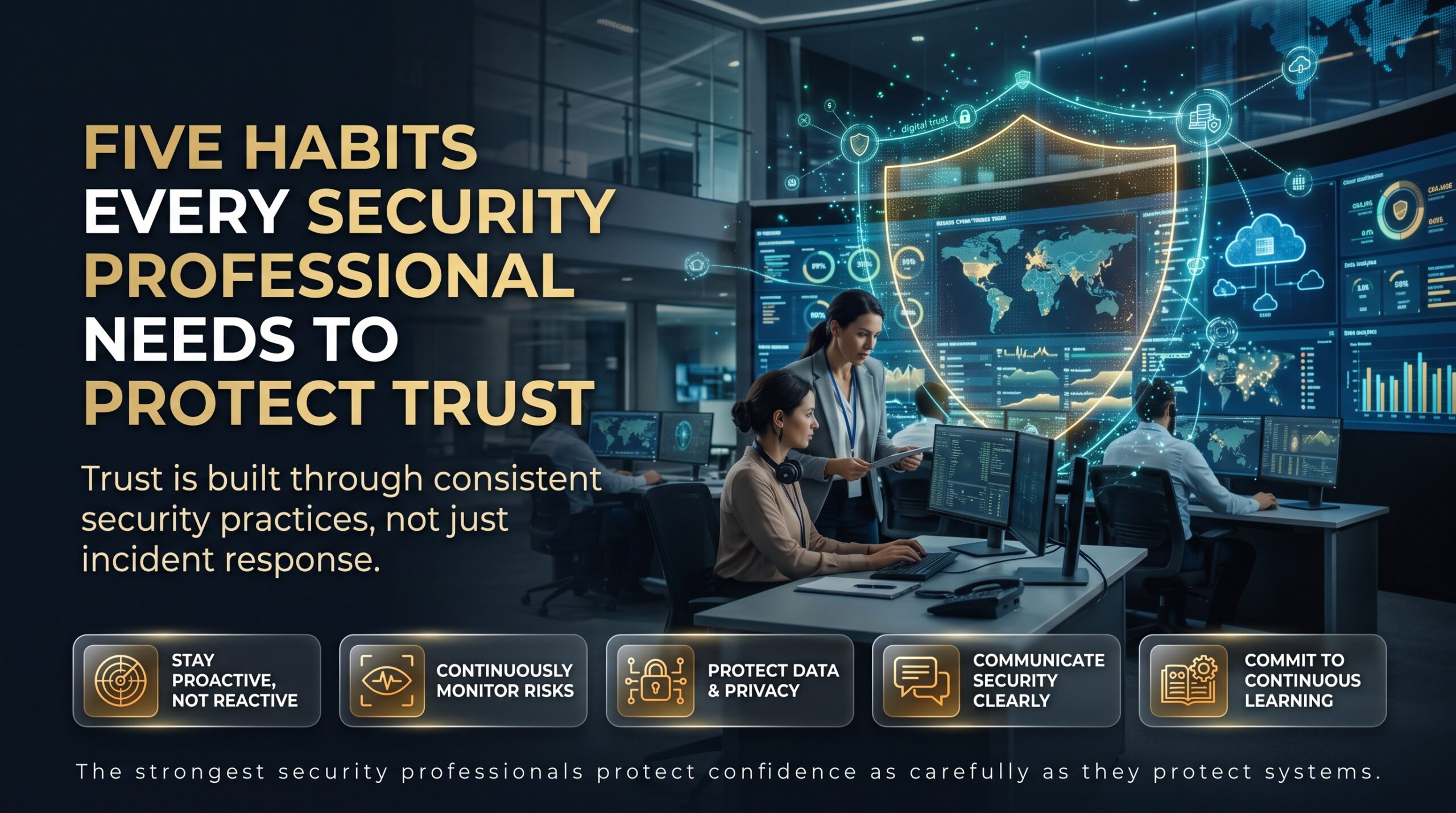
Five Habits Every Security Professional Needs to Protect Trust
1. Be honest early
Bad news doesn’t improve with age. Raising a concern early, clearly and without blame is one of the most valuable habits a security professional can build.
2. Write things down
Document decisions, incidents and fixes. Good records protect the organisation in an audit and protect you when someone asks why a choice was made.
3. Explain risk in plain language
Leaders don’t need acronyms. They need to know what could happen, how likely it is and what it would cost. Translate for them, and you become indispensable.
4. Practise before it matters
Run tabletop exercises and restore tests. Calm under pressure comes from repetition, not from reading a policy once.
5. Keep learning
Threats change constantly, and so should you. Regular training and renewal keep your skills current and your credibility intact. Our piece on the career resilience advantage explains why security professionals who keep learning stay valuable in uncertain times.
A Five-Minute Trust Check
Be honest with yourself, as a security professional would. Each “no” shows where you can grow.
- Can you explain, in one sentence, what trust your organisation is protecting?
- Do you know which regulations and frameworks apply to your industry?
- Have you tested your backups and incident plan in the last twelve months?
- Do you hold a current credential that shows you can be trusted with sensitive systems?
- Could you explain a recent risk to a non-technical manager without jargon?
Frequently Asked Questions
What is the hidden asset every security professional protects?
It’s trust: the confidence that customers, staff and partners have in an organisation to keep information safe and handle problems honestly. Technical controls exist to protect it.
What does a security professional do day to day?
A security professional’s typical work includes monitoring systems, managing access, patching, investigating alerts, testing defences, responding to incidents and explaining risk to the business. The exact mix depends on the role and the organisation.
Which certification should I start with?
Many beginners start with CompTIA Security+, then choose CySA+, PenTest+, PCNSA or AZ-500 based on the role they want. Our FAQ page covers common questions about choosing a course.
Do I need IT experience to become a security professional?
Many entry-level certifications don’t require prior experience, although a background in IT support or networking helps. Advanced courses usually expect some foundation in IT or security.
Protect Trust, Build a Career
The best security professionals understand that they’re not just defending machines. They’re defending the belief that makes digital business possible. If you can show that you understand that, and back it up with a recognised certification, employers will see someone worth trusting.
Ready to take the next step? Browse our cyber security courses, read more on the cyber security blog, learn about us on the About Us page, or contact our team to find the right pathway for you.