


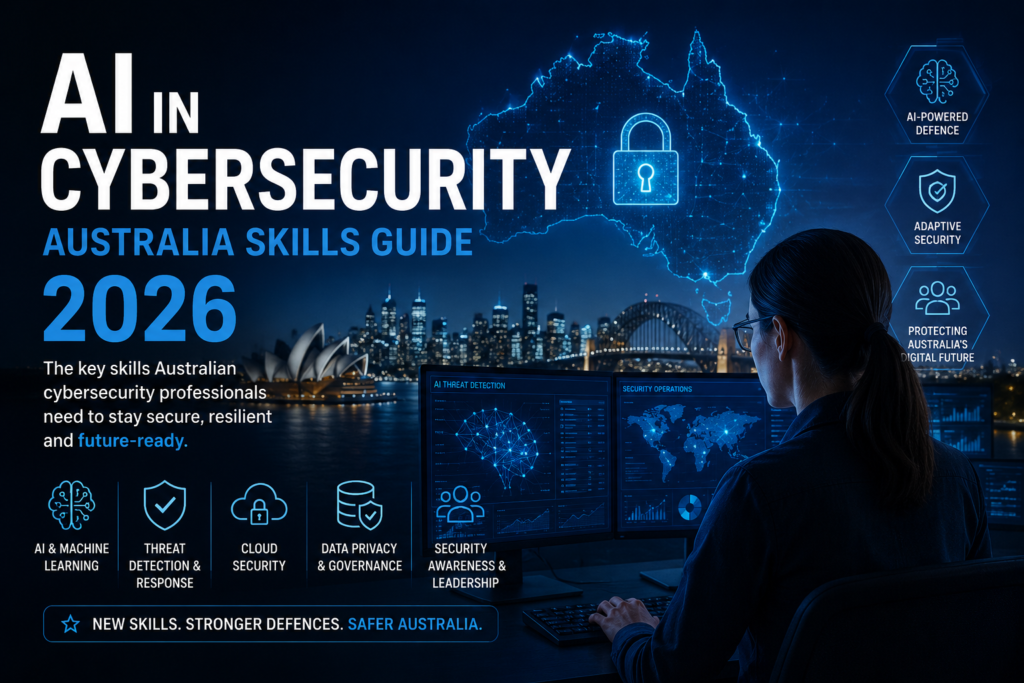
AI in cybersecurity has moved from buzzword to daily reality for Australian security teams. Attackers are using AI to write more convincing phishing emails and probe systems faster, while defenders are using AI-powered tools to detect anomalies, triage alerts, and cut through the noise of thousands of daily security events. For Australian cybersecurity professionals, 2026 is the year AI literacy stops being a “nice to have” and becomes a baseline expectation in job ads.
This guide covers exactly what’s changed, which skills employers are now screening for, and which certifications are worth pursuing if you want to stay relevant or get hired in this shift.
Why AI in Cybersecurity Matters Right Now
Security operations centres (SOCs) across Australia are drowning in alert volume, and AI-powered tools particularly those built into SIEM and XDR platforms are being adopted specifically to reduce analyst fatigue and speed up detection. At the same time, threat actors are using generative AI to craft more convincing social engineering attacks, automate reconnaissance, and generate malware variants faster than signature-based defences can keep up.
This dual shift means Australian employers aren’t just looking for traditional security knowledge anymore they’re looking for professionals who understand how AI changes both the attack surface and the defence toolkit.
New Skills Australian Cybersecurity Professionals Need in 2026
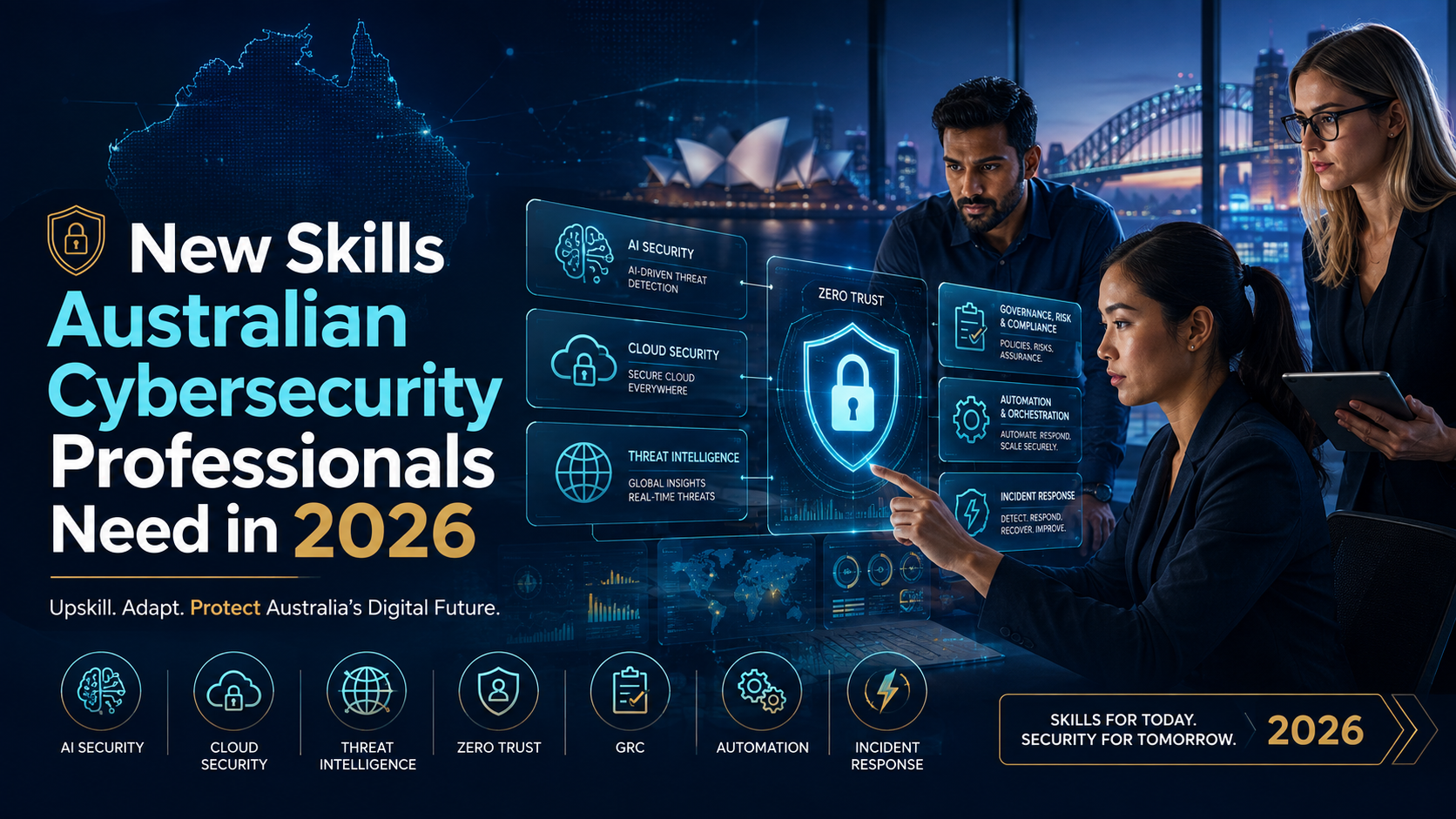
1. AI-Assisted Threat Detection and SOC Tools
Modern SOC analysts need working familiarity with AI-driven detection platforms tools that use machine learning to flag anomalies rather than relying purely on static rules. Understanding how these models generate alerts (and where they produce false positives) is now a core triage skill, not an advanced specialisation.
2. Prompt Engineering for Security Workflows
Security teams increasingly use generative AI to draft incident reports, summarise log data, or query threat intelligence feeds. Knowing how to write effective, precise prompts and how to verify AI-generated output rather than trust it blindly has become a genuinely practical workplace skill.
3. Understanding AI-Powered Attack Techniques
Defenders need to understand how attackers are using AI: deepfake-enabled social engineering, AI-generated phishing at scale, and automated vulnerability scanning. This isn’t theoretical — the Australian Cyber Security Centre has repeatedly flagged AI-enabled scams as a growing risk for Australian businesses.
4. AI Model and Data Security
As Australian organisations deploy their own AI tools internally, a new skill set has emerged: securing the AI systems themselves. This includes understanding prompt injection risks, data poisoning, model access controls, and how sensitive training data can leak through AI outputs.
5. Governance, Risk and Compliance for AI Systems
With Australia’s evolving approach to AI regulation and existing frameworks like the Privacy Act, security professionals increasingly need to understand compliance implications of deploying AI tools particularly where customer or health data is involved.
Certifications Worth Considering in 2026
Employers across Australia are still anchoring on foundational and intermediate cybersecurity certifications, but increasingly value candidates who pair them with AI-specific knowledge:
- CompTIA Security+ — still the most widely requested baseline certification in Australian cybersecurity job ads, and a sensible starting point before layering on AI-specific skills
- CompTIA CySA+ — strong fit for SOC analyst roles, given its focus on threat detection and behavioural analytics, which increasingly overlaps with AI-driven tooling
- Microsoft SC-900 (Security, Compliance, and Identity Fundamentals) — useful for professionals working across Microsoft’s security stack, where AI-powered tools like Microsoft Defender are embedded
- CompTIA PenTest+ — relevant for professionals who need to understand how AI is changing offensive testing and reconnaissance techniques
- AZ-500 (Azure Security Engineer Associate) — valuable for professionals securing cloud environments where AI workloads are increasingly hosted
None of these certifications are “AI certifications” in name, but each builds the foundation needed to understand where AI intersects with detection, cloud security, and compliance — which is where most Australian employers are actually hiring right now.
Which Roles Are Most Affected by AI in Cybersecurity?
- SOC Analysts — daily interaction with AI-assisted alert triage and detection tools
- Security Engineers — configuring and tuning AI-powered detection platforms
- GRC Professionals — assessing AI governance and compliance risk as organisations adopt AI tools
- Penetration Testers — adapting testing methodology to account for AI-generated attack techniques
How Australian Professionals Are Building These Skills
Rather than waiting for employers to define exactly what “AI cybersecurity skills” means, many Australian professionals are building a foundation through structured, instructor-led certification training and then layering AI-specific tool familiarity on top through hands-on practice. Logitrain’s cybersecurity certifications are delivered live online, meaning professionals in Sydney, Melbourne, Brisbane, Perth, Adelaide, and Canberra can train with the same instructors without relocating or commuting to a classroom.
A Practical Starting Point: What to Learn First
- Start with a foundational certification — Security+ or SC-900, depending on whether your focus is general security or the Microsoft ecosystem
- Build hands-on familiarity with AI-assisted SOC tools through labs or on-the-job exposure
- Layer on a specialisation — CySA+ for detection-focused roles, or AZ-500 for cloud security roles where AI workloads increasingly live
- Stay current on AI-enabled threats through resources like the Australian Cyber Security Centre’s alerts and advisories
Frequently Asked Questions
Do I need to learn AI/machine learning to work in cybersecurity now?
Not in the data-science sense. Most security roles need working familiarity with how AI tools generate alerts and flag risks, not the ability to build machine learning models.
Is there a dedicated “AI cybersecurity” certification?
Not yet as a widely recognised standard in Australia. Most professionals build relevant skills through established certifications like Security+, CySA+, and AZ-500, combined with hands-on exposure to AI-powered security tools.
Which certification should I start with in 2026?
CompTIA Security+ remains the most commonly requested baseline in Australian cybersecurity job ads, making it a sensible first step before specialising further.
Are AI skills replacing traditional cybersecurity skills?
No — they’re being layered on top. Employers still expect strong fundamentals in networking, threat detection, and risk management, with AI literacy as an added expectation rather than a replacement.
Final Thoughts
AI in cybersecurity isn’t a future trend for Australian professionals — it’s already reshaping how SOCs operate, how attackers work, and what employers screen for. The professionals best positioned for 2026 are combining solid foundational certifications with practical AI tool literacy, rather than waiting for a single “AI cybersecurity” credential to emerge.
Ready to build that foundation? Explore Logitrain cybersecurity certifications, delivered live online to professionals across Sydney, Melbourne, Brisbane, Perth, Adelaide, and Canberra.